

+86 177 5193 6871
222, Block B, Diamond International, Guozhuang Road, Xuzhou, Jiangsu, China
When you look up at the woven dome of Beijing’s Bird’s Nest or stroll through a spacious airport terminal, you may not have noticed the “backbone” supporting these magnificent structures—the space structure. Like the “unsung heroes” of architecture, they may be inconspicuous, yet they create safe and functional spaces in large venues, shopping malls, factories, and other settings. Today, we’ll help you see them for what they truly are.
1. Introduction to Space Structures
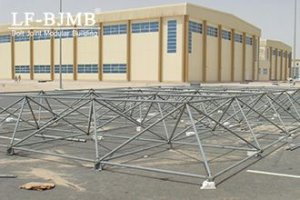
A space structure is essentially a spatial framework formed by connecting multiple members in a specific grid pattern through joints, much like a three-dimensional “woven net”: each member acts as a “wire,” and each joint serves as an “intersection,” collectively forming a stable load-bearing system. Unlike traditional planar structures, it distributes loads evenly across all members—much like a group of people working together to lift a heavy object, where each person bears a small portion of the weight, resulting in greater overall stability.
Based on practical applications, space structures are primarily classified into the following categories:
By number of layers: Single-layer space structures are relatively simple and suitable for buildings with smaller spans, generally no more than 30 meters; they are relatively rare in actual applications. Double-layer space structures are the most common type, consisting of upper and lower chords and web members. They offer good load-bearing performance and spatial rigidity and are widely used in various buildings; Three-layer space structures are suitable for buildings with exceptionally large spans exceeding 100 meters. However, due to the large number of joints and members, their complex construction, and higher costs, they are not widely used in domestic engineering projects.
By material: Classification by material includes steel space structures, aluminum space structures, wooden space structures, plastic space structures, reinforced concrete space structures, and composite space structures. Steel space structures, with their high strength, good toughness, and ease of construction, have seen the widest application in China; composite space structures combine with other materials such as concrete slabs to serve as floor slabs, enhancing the structure’s functionality and versatility.
By support method: These include perimeter support, four-point support, multi-point support, three-sided support, opposite-side support, and mixed support configurations. Perimeter support (supported on columns at all four sides) is the most common type, as it distributes loads evenly; large industrial buildings often use four-point or multi-point support to reduce the number of columns and maximize available space.
By configuration: They are divided into four major categories: cross-truss systems, triangular truss systems, quadrilateral truss systems, and hexagonal truss systems. Cross-truss space structures consist of two or three sets of planar trusses and are among the earliest forms of space structures adopted. Their upper and lower chords are of equal length, and common types include two-way and three-way space structures; triangular pyramid space frames are suitable for buildings with various planar shapes, such as squares, rectangles, and triangles, and are composed of triangular pyramids; Tetrahedral truss systems are composed of tetrahedrons and come in five forms, including square tetrahedral truss systems and square hollow tetrahedral truss systems, each with its own unique load-bearing characteristics and scope of application; hexagonal truss systems are composed of hexagonal pyramids and can be inverted or upright, with the primary form being the hexagonal truss system.
2. Characteristics of Space Structures
(1) Superior Mechanical Properties
The mechanical properties of space structures are exceptional, which is one of the key reasons for their popularity in the architectural field. The members within the space structure are primarily subjected to tensile or compressive forces, allowing the material strength to be fully utilized without wasting its performance. Whether it is the weight of the roof, the thrust of strong winds, or the impact of earthquakes, the structure distributes these forces throughout the entire framework via its joints, acting like an “elastic net” that securely absorbs various external forces.
(2) Lightweight and High-Strength Advantages
Space structures typically utilize lightweight, high-strength materials such as steel and aluminum alloys. Compared to traditional concrete structures, the self-weight of a space structure can be reduced by several times. With a lighter dead load, foundation requirements are reduced, allowing construction even in areas with poor geological conditions. During transportation and installation, components are easy to handle and do not require large-scale equipment, making construction more efficient.
(3) Flexibility and Adaptability
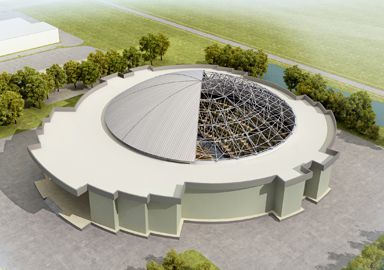
Space structures offer exceptional flexibility and adaptability, allowing for diverse designs tailored to architectural needs. Whether for regular shapes like rectangles and circles or irregular, non-standard structures, space structures can adapt perfectly. Flat-panel space structures are suitable for most industrial plants, warehouses, and similar buildings; curved and dome-shaped space structures are commonly used in landmark buildings such as sports stadiums and exhibition halls. For example, the unique shape of the Bird’s Nest was created by “weaving” a space structure; for airport terminals requiring large-span, column-free spaces, space structures can easily span the area, allowing for smoother passenger flow.
(4) Convenient and Efficient Construction
Components can be prefabricated in a factory, where stable production conditions ensure dimensional accuracy and quality. Once delivered to the construction site, they are assembled like building blocks. Compared to concrete structures, which require pouring and curing, the construction period for space structures can be shortened by more than one-third. For example, constructing a large sports arena using a space structure may take just over a year to complete—significantly faster than traditional methods—while also reducing on-site dust and noise, making it more environmentally friendly.
Copyright © Xuzhou LF Engineering & Construction Co., Ltd. All Rights Reserved.


 +86-17751936871
 +86-516-8595-0258


