

+86 177 5198 6706
222, Block B, Diamond International, Guozhuang Road, Xuzhou, Jiangsu, China
In large-span steel structure projects, many teams believe that once the drawings are approved and fabrication quality is controlled, the project is already under control.
But real project experience often proves otherwise.
A structure can be perfectly correct on paper and still face unexpected difficulties during installation.
Why?
Because a steel structure is not completed when the drawings are finished.
It must go through another critical transformation:
From engineering design to a real structure on site.
This transformation is where many hidden risks appear.
And this is why factory pre-assembly has become an important risk-control step for high-performance large-span steel structure projects.
For complex steel structures, especially:
the final project performance depends on how accurately every component works together.
Engineering drawings define:
But real construction introduces variables that drawings cannot fully show:
A small mismatch that appears insignificant during fabrication can become a major problem during installation.
The consequences may include:
The earlier these issues are discovered, the easier they are to control.
Many people see factory pre-assembly as simply checking whether components can be connected.
But for large-span steel structures, its value is much greater.
Pre-assembly is a full-system verification process.
It tests whether the designed structure can actually move from drawings into reality.
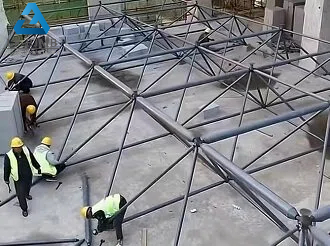
Large-span structures depend heavily on connection reliability.
A successful pre-assembly process helps confirm:
Because in large-span structures, connection issues rarely remain isolated.
A small coordination problem at one node can affect the entire installation process.
Design teams think in terms of:
Fabrication teams focus on:
Installation teams face:
The challenge is not that these stages are independent.
The challenge is making them work together.
Factory pre-assembly creates this connection.
It allows potential problems to be identified before they arrive at the construction site.
For projects where fabrication and installation are separated by long distances, solving problems after delivery can become extremely expensive.
Once components arrive at the site:
Factory verification changes the way risks are managed.
Instead of discovering problems during installation,
the project team identifies and solves them before shipment.
A successful steel structure project requires more than manufacturing capability.
It requires the ability to translate engineering intent into construction reality.
Design provides the structural logic.
Fabrication turns that logic into physical components.
Installation transforms those components into a completed structure.
The missing link between these stages is often coordination.
A professional steel structure partner does not only manufacture components.
It understands how design decisions affect fabrication and how fabrication decisions affect installation.
That is the real meaning of structural translation.
At LF-BJMB, we believe successful large-span steel structure projects are created before installation begins.
Our focus is not only on fabrication.
It is on ensuring that the complete structural system works as intended.
Through:
we help identify potential risks before they become site problems.
Because the real question is not only:
“Can the structure be fabricated?”
The more important question is:
“Can the structure be installed efficiently and perform reliably after completion?”
For large-span steel structures, the most expensive problems are often not caused by poor materials.
They are caused by gaps between:
Design.
Fabrication.
Transportation.
Installation.
Factory pre-assembly helps close these gaps.
It is not just a quality inspection step.
It is a project risk-control strategy.
Because a successful steel structure is not only designed correctly.
It must also be translated correctly from drawings into reality.
LF-BJMB — Engineering large-span structures through better coordination, better control, and better long-term reliability.
Copyright © Xuzhou LF Engineering & Construction Co., Ltd. All Rights Reserved.


 +86 177 5198 6706
 +86-516-8595-0258


