

+86 177 5198 6706
222, Block B, Diamond International, Guozhuang Road, Xuzhou, Jiangsu, China
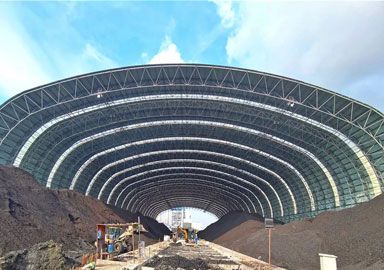
In thermal power plants, coal sheds are critical facilities that ensure the safe storage of coal and help reduce environmental pollution. Due to their long spans, lightweight design, and high strength, they have become standard features in modern thermal power plants. Common structural forms for coal storage sheds include space frame structures, shell structures, tubular truss structures, prestressed arch structures, and inflatable membrane structures. The table below lists the characteristics of each structure. Different structural types are selected based on span, taking into account indicators such as static performance, steel consumption, and stability.
1. Overview of Prestressed Tubular Trusses
(1) Definition
Typically composed of transverse prestressed tubular trusses, longitudinal tie trusses, supports, and gable trusses. The main structure utilizes components such as round steel tubes and rectangular steel tubes to form a spatial structural system, with intersecting joints—often directly welded to the members—commonly used at the nodes. Pre-stressed cable-supported tubular trusses build upon the foundation of ordinary tubular trusses by installing pre-stressed tension cables and diagonal cables at the bottom of the truss, interconnected via V-shaped struts. The tension cables and diagonal cables work in conjunction with the tubular truss to form a multi-level pre-stressed structural system, thereby improving the structural stress state.
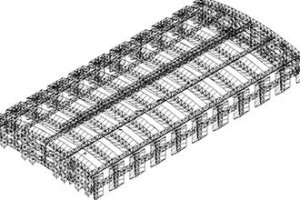
Schematic Diagram of a Pre-stressed Tubular Truss
(2) Structural Characteristics
Conventional tubular trusses can be understood as “beams,” converting the complex internal stress state of a beam under lateral bending into the simple tensile and compressive stresses of truss members. Prestressed cable-supported tubular trusses incorporate prestressed cables into the conventional tubular truss design, which improves the stress distribution within the tubes and reduces steel consumption by approximately 10% to 20%.
(3) Advantages
It can achieve larger structural spans; the joint configurations are relatively simple, facilitating rapid on-site construction; compared to traditional space frame structures, it requires less material and offers better economic efficiency; simultaneously, the structure requires minimal rust prevention and post-construction maintenance, resulting in lower operational and maintenance costs.
(4) Disadvantages
The fabrication and layout of intersecting joints in this structure are relatively complex, requiring high-level processing equipment and technical expertise; welding workloads are substantial and quality control requirements are strict, making the process highly dependent on the skill level of construction personnel; the heavy weight of spatial butt-jointed components demands high precision in on-site hoisting and alignment, posing greater challenges for construction organization and surveying control.
2. Typical Issues
(1) Missed Welds or Poor Welding Quality
With numerous intersecting members at joints, welding is difficult, and missed welds or poor weld quality frequently occur during construction, creating safety hazards for the structure during subsequent use.
(2) Installation Eccentricity
The installation accuracy of tubular trusses directly affects the structural load-bearing performance and overall stability. During construction, if the fabrication, assembly, and installation accuracy of components cannot be strictly controlled, installation eccentricity is likely to occur, causing changes in structural loading and compromising structural safety.
(3) Missing Members
Due to the large number and variety of members in prestressed tubular trusses, issues such as missing or removed members frequently occur during on-site installation. This alters the load-bearing conditions of the members and compromises structural safety.
(4) Slippage or Detachment of Connectors Between Members and Cables
(5) Slack in Prestressed Cables
Improper operations during construction and use can result in prestressed cables failing to meet design requirements, leading to slack.
(6) Corrosion of Members and Joints
Long-term exposure to harsh environments makes the steel in tubular trusses susceptible to corrosion.
3. Recommendations
Based on analyses of actual cases, the typical issues with many coal sheds primarily stem from construction quality defects and damage caused by operation and maintenance. The structure of prestressed tubular truss coal sheds is relatively complex, and the construction process involves high-altitude assembly; the precision and quality of this assembly significantly impact the structural safety of the coal shed. Additionally, during operation and maintenance, attention should be paid to whether coal piles exceed the specified limits, whether prestressed cables have slackened, and whether members exhibit corrosion or deformation. The following safety and maintenance recommendations are provided for prestressed tubular truss coal sheds:
(1) Quality Supervision and Inspection During Construction: During the construction phase, strict control over construction quality—particularly welding quality and installation precision—must be maintained. Through meticulous inspection, potential quality issues can be prevented from escalating into safety incidents, thereby ensuring both safety and quality throughout the construction process.
(2) Safety Inspection and Appraisal Prior to Final Acceptance: Conduct a safety inspection and appraisal after construction is completed but before final acceptance to ensure the safe subsequent use of the coal shed. By thoroughly understanding the structure’s actual condition and issues encountered during construction, we can develop more reasonable usage and maintenance plans, extend the structure’s service life, and reduce maintenance costs.
(3) Regular Inspections and Hazard Identification: Utilize equipment such as drones to conduct regular inspections and hazard identification for prestressed tubular truss coal sheds. It is recommended to perform a comprehensive safety hazard assessment every two years to monitor the structural damage and operational status of the coal shed, thereby providing a basis for routine maintenance.
(4) Periodic Inspection and Assessment: The prestressed cables in prestressed tubular truss coal storage structures may experience prestress relaxation due to long-term temperature fluctuations, typhoons, and other factors. Additionally, the corrosive environment of the coal yard can adversely affect the durability of the steel structure. Therefore, it is recommended that a comprehensive inspection and assessment be conducted every 5 to 10 years to provide the most reliable basis for the repair, reinforcement, and safe operation of the coal storage structure.
Through quality supervision and testing during construction, safety inspections and assessments prior to final acceptance, periodic inspections and hazard identification, and regular inspection and assessment, it is possible to address and resolve safety risks throughout the entire life cycle of prestressed tubular truss coal storage sheds. This ensures their safety and reliability, laying a solid foundation for operation and maintenance.
Copyright © Xuzhou LF Engineering & Construction Co., Ltd. All Rights Reserved.


 +86 177 5198 6706
 +86-516-8595-0258


