

+86 177 5193 6871
222, Block B, Diamond International, Guozhuang Road, Xuzhou, Jiangsu, China
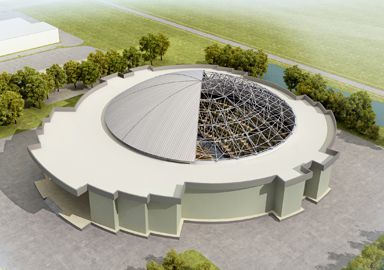
目前,螺栓连接球形钢结构因其美观、结构安全、经济高效、施工周期短等诸多优点,被广泛应用于水泥厂的储料棚建设中。然而,在这些钢结构的制造和安装过程中,有几个关键点需要我们格外注意。
1. 制造过程控制
(1)构件制造
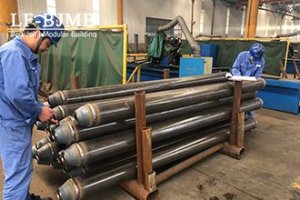
Member fabrication is a critical stage in steel structure construction where errors can easily accumulate. The cut-to-size dimensions of the steel tubes, the thickness of the end plates or tapered ends, and the weld bead thickness all determine the final length of the member. Furthermore, constrained by the designed member length, the cut-to-size dimensions of the steel tubes and the thickness of the end plates or tapered ends also determine the weld bead thickness; weld beads that are too thick or too thin directly affect the connection strength of the member. Therefore, during actual construction, the cutting dimensions of steel tubes must be controlled according to the specific welding components and their required weld thicknesses. This necessitates the fabrication of a “sample member” for members of the same specification to achieve the purpose of correcting cutting dimensions. Another key control point in member fabrication is end face perpendicularity, as this determines the size of the contact surface between the member and the bolted sphere. For load-bearing members in steel structures, non-perpendicular members often experience eccentric compression under actual load. In single-member cases, this prevents the member from fully utilizing its performance and causes deformation; in multi-member configurations, it reduces the safety performance of the steel structure. This necessitates rigorous parallelism checks during the temporary “alignment” of members prior to welding at both ends, and inspection of the “alignment platform” is also essential. A well-designed “alignment platform” should allow all components of the structural member to move freely and independently relative to one another, thereby ensuring optimal alignment results. Each member must also be inspected for any bending. Consequently, the alignment process is of critical importance. Speed should not be prioritized at the expense of quality, as this could create significant risks for subsequent work or lead to unnecessary rework.
Various quality defects may occur when welding steel tubes to end plates or conical heads, such as weld spatter, weld holes, undercut, lack of fusion, and uneven welds. The causes of each defect should be analyzed, and corrective measures should be implemented accordingly.
Additionally, the quality of the welding rods, their storage duration, and baking conditions are also critical factors affecting weld quality. After welding, the welds should be allowed to cool naturally at room temperature to ensure the stability of the weld material.
When removing rust from structural members, ensure that the specified design grade is achieved. For pipes with excessive rust or those that have been stored for an extended period, a second shot blasting should be performed. During the rust removal process, conduct a visual inspection to check for any inherent defects in the structural members. The spacing of the rust removal racks should not be too dense to ensure effective, all-around shot blasting.
Painting is the final process in the fabrication of steel structural members. Visually, paint should not exhibit sagging; the coating must be uniform, with no bare spots showing through. The second coat of paint must only be applied after the first coat has completely dried.
Additionally, during the processing of steel structural members, necessary visual inspections must be conducted on bolts and sleeves. Bolts must undergo Rockwell hardness testing; welds on structural members must be subjected to non-destructive testing according to specifications and batches; welding rods must undergo reliability testing prior to entry into the factory; and assembled finished structural members must undergo tensile testing, among other procedures.
(2) Bolted Sphere Processing
Bolted sphere blanks are forged from steel ingots, and their material quality is difficult to guarantee; therefore, quality control must begin at the source. Inspections of the blank spheres primarily focus on the presence of cracks, scale, and deviations in sphere diameter. A sphere diameter that is too small reduces the milled surface area, resulting in insufficient contact between the bolted sphere and the socket, which creates serious quality risks. Bolt spheres are made of 45 steel, and their quality must comply with the provisions of the national standard “Requirements for High-Quality Carbon Structural Steel” (GB 699).
Although the machining of bolt holes in bolt spheres is classified as coarse threading, it must adhere to the machining requirements for mechanical products, particularly ensuring that the tap penetration depth meets the subsequent bolt installation depth requirements. The primary control indicators are:
(1) The milled surface must ensure adequate contact with the sleeve.
(2) All bolt holes must be uniformly aligned toward the center of the sphere; the center of the lathe’s three-jaw chuck, the drill bit’s center, and the fixture’s center must be aligned. This requires frequent verification during the machining process.
(3) The hole formation angle must meet design requirements.
The machining process must be cleaned before machining begins. For the sampling inspection of finished spheres, angles can be checked by comparing them with similar bolt spheres on the drawings to assess the magnitude of errors. If machined process holes or finished spheres are not used for an extended period, they should be sealed to prevent rusting of the bolt holes. For new products, or after machining uncommon bolt holes, a bolt should be screwed in to verify proper engagement.
The machining process of bolted sphere steel structures determines the final quality of the steel structure; all trades must perform precise operations. Each work team should strictly control and standardize operations based on their specific characteristics. Work teams performing similar tasks should actively exchange experiences, learn from each other’s strengths, and align their understanding to effectively improve the quality of steel structure fabrication.
3. Process Control for the Installation of Bolted Sphere Steel Structures
(1) Installation Procedures for Bolted Sphere Steel Structures
Before installation, installation personnel must be thoroughly familiar with all members, sphere models, dimensions, and their positions as indicated on the drawings. Any deformation of members caused during transportation, storage, or hoisting must be corrected. All members and spheres must be marked. During installation, they must be carefully checked against the drawings to ensure correctness before proceeding. Steel structure installation primarily involves the connection between bolts and spheres. The friction surfaces of the components must be kept dry. High-strength bolts must be inserted smoothly into the sphere holes in a consistent direction and must be tightened in two stages. Each set of high-strength bolts must be fully tightened on the same day, and no bolts may be left untightened. Different installation methods should be adopted for different types of steel structures. Steel structures are generally classified as planar or curved, with support methods including multi-point support, two-sided support, and perimeter support. In planar steel structures, the upper chord members are typically compression members, while the lower chord members are typically tension members; consequently, the combined cross-sectional dimensions of the upper chords are generally larger than those of the lower chords when viewed as a whole. Deformation caused by self-weight during the installation of steel structures often hinders subsequent installation, particularly in large-span planar steel structures. Therefore, sliding construction methods should not be used for this type of steel structure. Full-area scaffolding is the most advantageous construction platform for steel structures; while ensuring construction safety, it can also bear part of the steel structure’s weight, effectively preventing grid subsidence and deformation, as well as correcting accumulated errors during installation and deviations between supports and embedded parts. Curved steel structures are analogous to arch structures, where most of the radial members are compression members (referring specifically to the upper curved surface type). Installing compression members is more challenging than installing tension members. Compression members should not be subjected to loads until installation is complete to prevent subsequent installation work from becoming impossible.
(2) Error Control in Bolted Sphere Steel Structure Installation
螺栓连接球形钢结构安装的质量控制主要在于控制安装误差并防止误差累积。首先,预埋件必须调平并标记轴线,以确保支撑满足设计条件下的安装要求;不符合要求的预埋件必须及时处理。其次,工作平台上必须设置足够的结构支撑点,以防止钢结构在完全成型前发生沉降,从而影响安装效果。此外,制造过程中产生的误差会在安装过程中累积;因此,在安装完单个或多个单元后,必须逐一核对网格尺寸,并做好记录。如果在钢结构安装过程中发现误差累积过多,影响后续安装,则必须停止安装,分析原因并及时纠正。对于大跨度钢结构,在安装单跨时,螺栓不应一次性完全拧紧,以便后续调整因误差累积或脚手架平台支撑不足造成的轴承偏差。平台支撑的高度可以通过千斤顶进行调节,但必须确保脚手架的强度和稳定性。
(3)螺栓连接球形钢结构安装过程中的其他注意事项
首先,在搬运结构构件时,应防止人为因素造成的变形,并确保成品得到妥善保护。其次,应确保螺栓的有效插入长度,并确认锁紧垫圈完全嵌入其槽内且位置正确。这一点对于承受动态荷载的钢结构尤为重要,因为螺栓在长期动态荷载作用下容易松动。此外,值得注意的是,虽然允许在支撑点处将球体与支撑板焊接连接作为结构焊接,但严禁在钢结构内部不同材料之间进行任何形式的焊接。钢结构安装过程中需要使用实用有效的安装平台。应利用安装平台和其他条件,确保受压构件不承受压应力。安装过程中应检查网格尺寸,以防止误差累积。
4. 结论
螺栓连接的球形钢结构在制造和安装方面都要求极高的精度。因此,在这些阶段,我们必须重点严格控制关键步骤。只有这样,才能提高钢结构的安全性和可靠性,并从源头上消除潜在的质量和安全隐患。
Copyright © Xuzhou LF Engineering & Construction Co., Ltd. All Rights Reserved.


 +86-17751936871
 +86-516-8595-0258


