

+86 177 5198 6706
222, Block B, Diamond International, Guozhuang Road, Xuzhou, Jiangsu, China
1. Types and Classification of Space Frame Structures
Currently, there are 15 common types of space frames, grouped into four main categories.
(1) Category 1: Space frames composed of planar truss systems. These are divided into four types based on the number of planar truss systems and their orientation:
a) Two-way orthogonal, orthogonally oriented space frames
b) Two-way orthogonal, diagonally oriented space frames
c) Two-way diagonally intersecting, diagonally oriented space frames
d) Tridirectional space frames
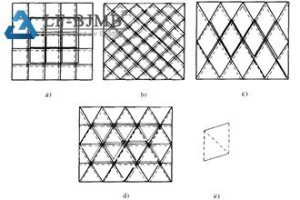
Space frames composed of planar truss systems
(2) Category 2: Space frames composed of four-sided pyramids. Based on the arrangement of the pyramids and the orientation of the connecting chords at the pyramid apexes, they are divided into 6 types:
a) Upright four-sided pyramid space frames
b) Upright four-sided pyramid space frames with voids
c) Inverted four-sided pyramid space frames
d) Checkerboard-patterned tetrahedral space frame
e) Star-shaped tetrahedral space frame
f) Unidirectional zigzag space frame, also known as a folded-plate space frame
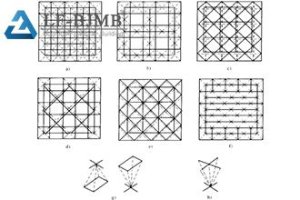
Space frames composed of tetrahedrons
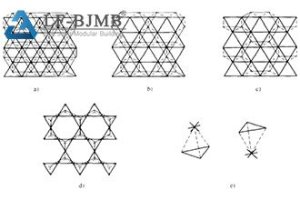
(3) The third category consists of space frame structures composed of triangular pyramids. Based on the arrangement of the triangular pyramids and the method of connecting the apex chords, they are classified into four types:
a) Triangular pyramid space frame
b) Open-core triangular pyramid Type I space frame
c) Open-core triangular pyramid Type II space frame
d) Honeycomb-shaped triangular pyramid space frame
Space frames composed of triangular pyramids
(4) The fourth category consists of space frame structures composed of hexagonal pyramids.
Space frames composed of hexagonal pyramids
1. In addition to the 15 types of space frame structures within the four major categories mentioned above, many new space frame structures have been developed. Examples include: composite space frame structures, hybrid space frame structures (prestressed space frame structures, cable-stayed space frame structures, suspended space frame structures), and other novel space frame structures (open-web space frame structures, folded-plate space frame structures, three-layer and multi-layer space frame structures, and bird’s nest-shaped space frame structures).
2. Selection of Space Structures
The main factors influencing the selection of space frame structures include fabrication and installation methods, steel consumption requirements, span size, stiffness requirements, plan geometry, and support conditions.
(1) If welded joints are used, space Structures composed of planar truss systems are easier to fabricate than those composed of four-corner pyramids; two-way orthogonal space frames are easier to fabricate than two-way oblique or three-way space frames; and four-corner pyramid space frames are easier to fabricate than triangular pyramid space frames.
(2) When the installation method for a space frame does not involve lifting or hoisting the entire structure as a single unit, but instead involves installing it in sections or blocks, or using the high-altitude sliding method, it is more advantageous to select one of the three types of orthogonal, upright-mounted space frames—such as two-way orthogonal upright-mounted space frames, upright-mounted four-corner pyramid space frames, or upright-mounted four-corner pyramid space frames with voids—rather than slanted-mounted space frames. This is because, during strip-by-strip or block-by-block hoisting, the latter type often requires the addition of temporary supports due to insufficient stiffness or geometric variability, which is not cost-effective.
(3) The steel consumption of the space frame itself is an important factor in determining the appropriate design. For example, in the case of perimeter-supported space frames with a nearly square plan, a full-stress optimization design comparison shows that the steel consumption is lower for the diagonal-oriented four-corner conical space frame and the checkerboard-pattern four-corner conical space frame. This is because these two types of space frames have smaller upper chord mesh sizes, shorter members, and reduced cross-sectional reductions during stability checks for compression members, resulting in higher material utilization efficiency; the lower chord mesh is larger, the tension members are longer, and the number of nodes and members is smaller, resulting in reduced steel consumption. For space frames with a side-to-side ratio greater than 1.5, due to the distribution of internal forces, orthogonal and upright space frames generally consume less steel than inclined space frames under identical conditions. Some open-corner conical space frames generally require less steel than closed-corner conical space frames; however, the variation in member internal forces in open-corner conical space frames is greater than in closed-corner ones, which is disadvantageous for joint design and member selection.
(4) Calculations indicate that span size (for space frame structures, spans over 60 m are considered large, spans under 30 m are considered small, and spans between 30 and 60 m are considered medium) has little impact on the selection of space frame types. However, large-span space frames are generally used in important buildings. Currently, the most commonly used space frame structures in China are those composed of planar truss systems such as two-way orthogonal orthogonal space frames, two-way orthogonal oblique space frames, and three-way space frames. This is because there is extensive design and construction experience with these types of large-span space frames, and the technology is well-established. In contrast, three-way space frames, triangular-cone space frames, and hexagonal-cone space frames generally have more complex structures and require large amounts of steel; therefore, they should be used sparingly in small- and medium-span applications.
(5) The stiffness of space frames is significantly better than that of planar roof trusses; however, there are considerable differences in both horizontal and vertical stiffness among various types of space frames. For example, the inclined four-corner conical space frame is inherently geometrically variable; its geometric stability can only be ensured by adding edge members or incorporating strong ring beams. Generally speaking, space frames with a larger number of joints and members—such as triangular conical, hexagonal conical, and triaxial space frames, orthogonal tetrahedral space frames, possess greater stiffness. Conversely, structures such as inclined tetrahedral space frames, checkerboard tetrahedral space frames, open-cell triangular tetrahedral Type I and II space frames, and honeycomb triangular tetrahedral space frames have fewer nodes and members, resulting in lower stiffness.
(6) For space frames with circular, regular hexagonal, or nearly circular polygonal plans, three-way space frames, hexagonal pyramid space frames, triangular pyramid space frames, open-cell triangular pyramid Type I and II space frames, and honeycomb triangular pyramid space frames are generally more suitable in terms of plan layout and architectural form. This is particularly true for regular hexagonal plans, where these types of space frames feature a regular grid pattern. There are fewer types of members, making construction more convenient; if other types of space frames are used, the mesh near the boundaries becomes irregular and disorganized, the number of member types increases, and fabrication becomes more difficult.
(7) For multi-point supported space frames, orthogonal and parallel-layout space frames are more suitable. This is because, under multi-point support, the load-bearing performance of such orthogonal and parallel-layout space frames is more rational than that of diagonal-layout space frames, and they exhibit smaller deflections. Calculations for four-point-supported space frames indicate that, under identical conditions, the ratio of maximum internal forces between two-way orthogonally oriented and two-way obliquely oriented space frames is approximately 5/7, and the deflection ratio is approximately 6/7. Furthermore, obliquely oriented space frames require additional edge members at the free boundaries, increasing the number of members and material consumption. For space frames with three-sided support and one open end, orthogonally placed space frames are also recommended. For space frames combining perimeter support with multi-point support, either orthogonally placed or obliquely placed space frames may be used; however, three-way space frames and those composed of triangular or hexagonal pyramids are generally not recommended.
(8) For floors in multi-story buildings with spans not exceeding 40 m and roof structures with spans not exceeding 60 m, composite space frames with reinforced concrete slabs replacing the steel upper chords may be used; For composite space frames, it is advisable to select orthogonally oriented four-sided pyramidal composite space frames, orthogonally oriented four-sided pyramidal composite space frames with voids, two-way orthogonally oriented composite space frames, obliquely oriented four-sided pyramidal composite space frames, and honeycomb-shaped triangular pyramidal composite space frames. Overall, the selection of a space frame type is a relatively complex issue that must be determined through comprehensive analysis and comparison of multiple options based on the principles of practicality and economy. Among the factors affecting the selection discussed above, the most critical considerations should be construction and fabrication, as well as steel consumption.
Copyright © Xuzhou LF Engineering & Construction Co., Ltd. All Rights Reserved.


 +86 177 5198 6706
 +86-516-8595-0258


