

+86 177 5198 6706
222, Block B, Diamond International, Guozhuang Road, Xuzhou, Jiangsu, China
Designing long-span steel structures requires looking beyond mere span dimensions, one must comprehensively consider five core factors: overall load-bearing capacity, wind resistance, joint detailing, material quality, and construction precision. Only through scientific load calculations and specialized structural design can the long-term, safe, and stable operation of column-free, large-space buildings be guaranteed.
Why are the design standards for long-span steel structures significantly higher than those for standard industrial plants?
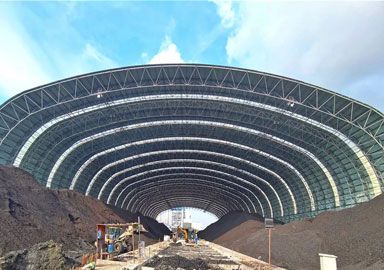
Compared to conventional small-span steel factory buildings, long-span structures—such as coal storage sheds, clinker silos, aircraft hangars, and stadiums—present a larger surface area exposed to wind, greater structural flexibility, and more complex load transfer paths. Inadequate design considerations can easily lead to issues such as excessive deflection, wind-induced oscillation, and local instability.
Therefore, the design of long-span steel structures cannot rely on generic templates, instead, it requires specialized, refined design tailored to specific project conditions, site environments, and operational needs, ensuring comprehensive control over structural safety margins.
Five Core Key Factors in Long-Span Steel Structure Design
Load-bearing capacity is the fundamental basis of long-span steel structure design and the core component of load calculations.
During the design phase, it is essential to comprehensively evaluate all load conditions across the building’s entire lifecycle, avoiding design deficiencies that might arise from verifying only a single load case.
Precise calculations are required for loads such as the structure’s self-weight, roof live loads, operational loads from on-site equipment, and natural loads (wind and snow). By verifying various load combinations, engineers ensure that the overall structure, member cross-sections, and foundation bearing capacity meet regulatory standards. Adequate safety margins are incorporated to prevent safety hazards—such as structural deformation or insufficient load-bearing capacity—resulting from long-term loading.
Wind load is the most critical variable load affecting the safety of long-span steel structures and a primary focus in the design of all ultra-long-span buildings.
Long-span buildings often feature expansive roof areas and high overall permeability, making them highly susceptible to wind pressure, wind-induced vibration, and roof suction (negative pressure). This is particularly critical in coastal typhoon-prone zones, open industrial sites, and high-altitude regions with strong winds, where wind resistance design directly determines the building’s service life.
During the design process, it is essential to analyze wind pressure distribution, structural wind-induced vibration responses, and the uplift resistance of roofing and envelope systems. By integrating the wind-resistance characteristics of various structural forms—such as arches, space frames, and trusses—the building’s shape and component configuration can be optimized to effectively withstand strong winds and prevent issues like roof uplift, structural oscillation, and connection loosening.
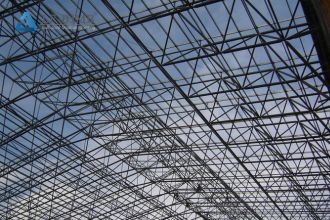
In long-span spatial steel structures, connections serve as the critical hubs for load transfer between members and for ensuring the structure acts as a unified system; the soundness of the connection design directly determines the stability of the entire structure.
Unlike conventional steel structures, long-span structures—such as space frames and tubular trusses—rely on a vast number of connections to facilitate multi-directional load transfer. Designs must strictly ensure the continuity and uniformity of this transfer while eliminating stress concentrations.
Simultaneously, the design must balance connection strength with overall structural stability. It must ensure that connections remain secure and functional—without loosening, failure, or displacement—under the influence of wind, snow, seismic activity, and cyclic equipment loads, thereby guaranteeing the stable operation of the integrated load-bearing system.
The quality of raw steel is the foundation of structural safety; material selection and fabrication precision directly impact the successful realization of the design.
Long-span steel structures impose rigorous requirements regarding steel strength grades, material stability, and weldability. Key indicators—such as the quality of the base steel, dimensional accuracy during fabrication, and surface treatment processes—must be strictly controlled.
Comprehensive quality control—spanning raw material inspection upon arrival, factory prefabrication, and final product testing—is essential. This prevents the use of non-compliant materials or components with excessive fabrication errors, thereby eliminating structural safety hazards at the source and ensuring that the actual engineering performance aligns precisely with the design’s load-bearing capacity.
A well-conceived design requires standardized construction to be effectively realized; construction quality serves as the final line of defense for the safety of long-span steel structures.
Long-span spatial structures demand extremely high installation precision. During the construction phase, critical processes must be rigorously managed, including component alignment and installation accuracy, the tightening quality of high-strength bolts, on-site welding procedures, and the overall structural alignment and leveling. Precise installation ensures uniform load distribution across members, tight-fitting connections, and controllable structural deformation, thereby preventing issues such as installation errors, loose bolts, or welding defects that could compromise structural integrity and stability.
Professional safety design for long-span steel structures requires comprehensive management across five key dimensions: load-bearing capacity, wind resistance, connection detailing, material quality, and installation precision.
Load calculations determine the structural foundation’s capacity; wind-resistant design addresses extreme weather conditions; connection design ensures overall structural stability; and material and construction quality provide the essential support for realizing the design and ensuring long-term safety. These five factors are mutually reinforcing and indispensable, forming the core requirements for compliance with design standards for long-span steel structures.
The safety of long-span steel structures is never determined by a single component or process alone; rather, it relies on a scientific design system.
From precise initial load calculations and specialized wind-resistance and connection designs to rigorous mid-stage material quality control and standardized final installation, strict adherence to design standards throughout the entire process is essential to create large-space steel structures that are safe, stable, durable, and suitable for long-term industrial operations.
A: There are five key factors: overall load-bearing capacity and load calculations, specialized wind-resistant design, connection design, quality control of raw steel materials, and quality management of on-site installation.
A: Long-span spatial structures rely on connections to transfer loads in multiple directions; connections serve as both potential weak points and core hubs within the overall structural system. Substandard connection design can directly lead to localized stress concentrations and structural instability.
Copyright © Xuzhou LF Engineering & Construction Co., Ltd. All Rights Reserved.


 +86 177 5198 6706
 +86-516-8595-0258


