

+86 177 5193 6871
222, Block B, Diamond International, Guozhuang Road, Xuzhou, Jiangsu, China
In the realm of industrial architecture, the functional requirements of factory buildings differ significantly from those of ordinary structures. They must accommodate the spatial demands of installing large equipment and arranging production lines while also ensuring rapid commissioning and long-term durability under complex operating conditions. Steel structures, with their exceptional adaptability to these needs, have become the preferred choice for constructing factory buildings in manufacturing, warehousing and logistics, power plants, and other sectors.
1. Advantages of Steel Structure Factory Buildings
From the core requirements of industrial facilities, steel structures offer particularly prominent benefits.
(1) Large, Column-Free Spaces: Industrial production often demands expansive, unobstructed areas to facilitate the placement and future adjustments of overhead cranes and assembly line equipment. Through systems like trusses and portal frames, steel structures can easily achieve spans exceeding 30 meters with flexible column spacing, allowing customized spatial divisions tailored to production processes.
(2) Short Construction Cycle: For efficiency, steel structures employ a “factory prefabrication + on-site assembly” model. Components are standardized in factories and rapidly assembled on-site via bolting or welding. Main structure construction for typical industrial buildings can be completed in 3-6 months—nearly halving the timeline compared to concrete structures.
(3) Controllable Costs: Cost management and durability are key factors in selecting steel structures for industrial buildings. Under identical load conditions, steel structures weigh only one-third to one-fifth of concrete structures, significantly reducing foundation bearing pressure and lowering foundation engineering costs;
(4) Superior Durability: Steel’s high strength and compact cross-sections minimize spatial footprint, maximizing usable floor area. In industrial environments characterized by high temperatures, humidity, and dust, steel structures resist corrosion and wear through treatments like anti-corrosion coatings and weathering steel, extending facility lifespan and reducing long-term maintenance costs.
2. Typical Applications
In practical scenarios, steel structures demonstrate exceptional adaptability.
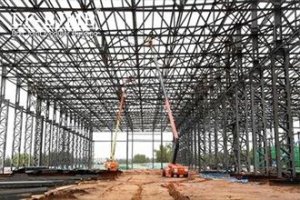
In manufacturing facilities, large-span steel structures accommodate heavy machinery and automated production lines while facilitating future equipment upgrades and workshop renovations.
Steel structures in coal storage sheds and logistics warehouses provide extensive coverage while reducing overall load through lightweight roofing, meeting spatial demands for cargo handling and storage;
In power plant workshops, steel structures accommodate the installation and maintenance of large-scale power generation equipment in critical areas like turbine rooms and boiler rooms, ensuring structural stability and operational safety.
3. Future Trends
Globally, the development potential of steel structure industrial buildings continues to expand. In emerging industrial regions like Africa and Southeast Asia, robust demand for industrial park development and manufacturing investments aligns perfectly with steel structures’ advantages of rapid construction, cost-effectiveness, and scalability—ideal for supporting these areas’ rapid industrial growth.
Today, as industrial production demands greater spatial flexibility and construction efficiency, steel structures will see broader application in industrial facilities. They represent a key driver propelling industrial architecture toward greater efficiency, economy, and sustainability.
Copyright © Xuzhou LF Engineering & Construction Co., Ltd. All Rights Reserved.


 +86-17751936871
 +86-516-8595-0258


