

+86 177 5193 6871
222, Block B, Diamond International, Guozhuang Road, Xuzhou, Jiangsu, China
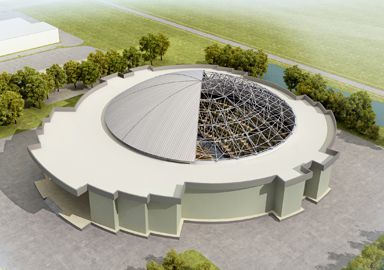
A space frame structure is a type of spatial grid structure composed of approximately identical grid units or smaller-sized components. Generally, flat-plate spatial grid structures are simply referred to as flat space frame. In recent years, most large-scale public buildings, especially the roofs of sports buildings, have adopted space frame structures. Moreover, the application of space frame structures in engineering offers the following advantages: spatial load-bearing capacity, simplified force transmission paths, lightweight construction, favorable economic indicators, high stiffness, excellent seismic performance, convenient construction and installation, standardized and commercialized production of truss members and nodes, and flexible layout planning.
Key Design Points for Stadium Space Frame Structures
The design of space frame structures for stadiums should include calculations for internal forces and displacements under external loads. Depending on specific conditions, calculations for internal forces and displacements under seismic actions, temperature variations, support settlements, and construction loads should also be performed.
1.Basic Assumptions for Internal Force Calculations.
1)Nodes are assumed as hinged connections, with members only subjected to axial forces.
2)Calculations are based on small deflection theory.
3)Analysis follows the elastic method.
2.External Loads on Space Frame Structures.
External loads are applied to the nodes following the principle of static equivalence. When local loads act on members, the influence of bending moments should be considered separately.
3.Primary Calculation Methods for Space Frame Structures (Recommended in Space Frame Design Codes).
1)Spatial Truss Displacement Method. Suitable for various types of trusses and different support conditions.
2)Cross Beam System Difference Method. Used for space frame composed of planar truss systems or orthogonal square pyramid trusses with spans below 40 m.
3)Pseudo Sandwich Plate Method. Applied to space frame composed of planar truss systems or pyramid units with spans below 40 m.
4)Fictitious Moment Method. Used for estimating internal forces in oblique square pyramid space frames and checkerboard square pyramid space frames.
4.General Principles for Seismic Design.
1)Horizontal seismic actions should be calculated separately along two principal axes, with each direction’s seismic action resisted by the corresponding lateral force-resisting elements.
2)For structures with oblique lateral force-resisting elements, when the intersection angle exceeds 15°, horizontal seismic actions should be calculated separately for each lateral force-resisting element direction.
3)For long-span and long cantilever structures under seismic fortification intensities of 8 or 9, vertical seismic effects should be considered.
5.Other Design Principles.
1)Based on the configuration of support nodes, they may be assumed as hinged supports with two-way lateral displacement, one-way lateral displacement, no lateral displacement, or elastic supports.
2)Allowable Deflection for Space Frame Structures: Roof structures ≤ span/250, floor structures ≤ span/300.
LF-BJMB offers large-span prefabricated steel structures solutions for you. If you have any projects, please feel free to contact us at any time.
Copyright © Xuzhou LF Engineering & Construction Co., Ltd. All Rights Reserved.


 +86-17751936871
 +86-516-8595-0258


