

+86 177 5198 6706
222, Block B, Diamond International, Guozhuang Road, Xuzhou, Jiangsu, China
For industrial facilities such as mining plants, power stations, port terminals and bulk material handling structures, structural design is usually completed long before fabrication begins. Understanding how engineering decisions affect fabrication, transportation and installation is essential for successful steel structure solutions
Engineering calculations are reviewed.
Drawings are approved.
Steel quantities are confirmed.
However, projects with similar structural systems can still experience completely different results during construction.
Some projects move through fabrication and erection with predictable progress. Others encounter repeated site adjustments, installation delays and unexpected coordination problems.
In many cases, the difference is not related to structural design capacity.
It comes from how effectively the approved design is translated into a fabrication and installation package.
This transition period between engineering approval and physical construction is often underestimated, yet it has a direct impact on project execution.
For complex industrial steel structures, fabrication is only one stage of the delivery process.
Before the first component enters production, several practical questions need to be resolved:
Can fabricated members be transported within local road, port and lifting limitations?
Does the planned member segmentation support the erection sequence?
Are connection details practical for site installation teams?
Can designers, fabricators and contractors working under different standards interpret the drawings consistently?
These questions become especially important for projects involving different engineering codes, international supply chains and multiple construction teams.
Many field issues are not caused by poor fabrication quality.
They are often caused by decisions that were not fully evaluated before manufacturing started.
A drawing can be technically correct and still create challenges during construction.
A connection detail may satisfy structural requirements but increase installation difficulty.
A large fabricated member may improve workshop efficiency but create transportation or lifting limitations.
A design prepared under one standard may require additional coordination when interpreted by teams working with different engineering practices.
Constructability review addresses this gap.
The purpose is not to change the structural design.
The purpose is to ensure that the designed structure can be fabricated, transported and installed efficiently under actual project conditions.
Approved drawings should not be considered the final checkpoint before production.
Before fabrication begins, structural details should be reviewed together with:
civil interfaces
equipment requirements
erection sequence
transportation limitations
site installation conditions
Early coordination helps identify potential conflicts before they become costly field modifications.
Member segmentation should be determined based on the complete delivery process, not only workshop convenience.
Producing larger components may reduce fabrication operations, but it can introduce challenges related to:
transport permits
road restrictions
site access
lifting capacity
erection sequence
Effective steel fabrication planning requires a balance between manufacturing efficiency and installation practicality.
Dimensional inspection confirms whether individual components meet manufacturing tolerances.
However, complex steel structures involve multiple members, interfaces and connection points that must work together during erection.
Factory pre-assembly provides an additional verification step by confirming that fabricated components function as an integrated system. This approach is supported by LF-BJMB’s integrated manufacturing and construction process, where engineering, fabrication and installation requirements are considered together before delivery.
Identifying an interface issue inside the workshop is usually far more efficient than resolving the same issue after shipment and during site installation.
At LF-BJMB, steel fabrication is considered one part of the overall project delivery process.
For industrial steel structure projects, our engineering teams review each steel package from the perspective of actual construction execution.
This includes:
engineering coordination
shop detailing verification
fabrication quality control
factory pre-assembly
transportation planning
installation technical support
Through continuous project experience, LF-BJMB has developed internal engineering control methods designed to reduce uncertainty before steel components leave the workshop.
Our delivery process connects six key stages:
Engineering Review
Shop Detailing Verification
Fabrication Quality Control
Factory Pre-Assembly Verification
Transportation Planning
Installation Technical Support
Rather than treating these activities as separate steps, information is transferred throughout the process to identify potential issues earlier.
For projects based on EN, ASTM and other international standards, this approach helps reduce interpretation gaps between designers, manufacturers and installation teams.
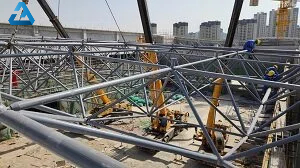
The impact of a problem usually increases as a project moves closer to installation.
A connection issue discovered during factory verification may require a local adjustment.
The same issue identified after shipment can affect:
transportation schedules
crane planning
manpower allocation
installation progress
For this reason, constructability review should begin before fabrication starts, not after steel arrives at site.
A steel structure subcontractor is not responsible for the complete EPC scope.
However, its role extends beyond manufacturing steel members according to approved drawings.
A reliable subcontractor must understand how the steel package will be:
engineered
fabricated
transported
assembled
integrated into the final facility
This requires manufacturing capability, but it also requires engineering coordination and practical understanding of construction execution.
LF-BJMB provides steel structure subcontracting services for industrial projects including mining facilities, power plants, port terminals, industrial plants and bulk material handling structures. With decades of experience in steel structure engineering and project execution, LF-BJMB supports EPC contractors and project owners in reducing execution uncertainty from design coordination to installation.
Our engineering support focuses on improving execution reliability through:
constructability review
design coordination
transportation-oriented detailing
factory pre-assembly verification
installation technical support
By connecting engineering decisions with fabrication and installation requirements, LF-BJMB helps EPC contractors and project owners reduce uncertainty before steel components leave the workshop.
Facing complex steel structure fabrication, transportation or installation challenges?
Contact LF-BJMB’s engineering team for a constructability review and explore how a structured execution approach can improve project predictability.
Copyright © Xuzhou LF Engineering & Construction Co., Ltd. All Rights Reserved.


 +86 177 5198 6706
 +86-516-8595-0258


