

+86 177 5198 6706
222, Block B, Diamond International, Guozhuang Road, Xuzhou, Jiangsu, China
In international steel structure projects, a recurring issue appears across mining facilities, energy plants, port terminals, and industrial expansions:
Identical construction drawings often lead to completely different on-site execution outcomes across countries.
In some projects, steel components arrive and are installed smoothly with minimal adjustment.
In others, teams face persistent fit-up issues, unexpected rework, and repeated installation delays.
The drawings are identical.
The fabrication quality is compliant.
Yet the final result is inconsistent.
This is not a design failure or fabrication defect.
It is a cross-border execution interpretation gap hidden inside global EPC delivery systems, which can only be eliminated via LF’s full integrated steel structure delivery service.
A common assumption in procurement and project execution is:
If the design drawings are the same, the construction result should also be the same.
This assumption works in standardized manufacturing systems.
However, steel structures are not manufactured products — they are site-assembled engineering systems.
Across different countries, execution is influenced by:
Local construction codes and engineering interpretation
Fabrication workshop habits and tolerance practices
Site installation experience and lifting logic
Regional construction sequencing preferences
As a result, identical drawings are interpreted differently at execution level.
International projects often operate across EN, ASTM, and local industrial codes.
Differences appear in:
Connection detailing rules
Welding and bolting requirements
Fabrication tolerance acceptance standards
Even small deviations in interpretation create cumulative assembly misalignment on site.
Most steel drawings define geometry and structural requirements, but often do not fully define:
Factory pre-assembly assumptions
Component segmentation logic
Erection sequence priorities
Field adjustment boundaries
Fabrication teams optimize based on workshop efficiency.
Site teams operate based on installation feasibility.
Without alignment, the two systems drift apart.
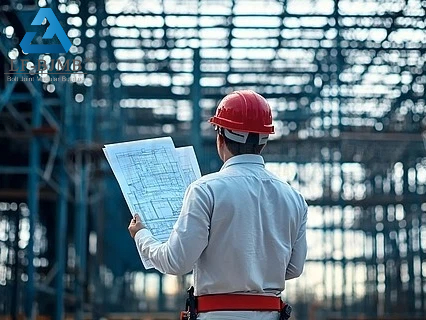
Critical construction constraints are often not explicitly defined in drawings, such as:
Lifting path limitations
Temporary stability requirements
Interface priority between structural elements
On-site assembly sequence dependencies
These are left to local interpretation, which varies significantly across regions.
These issues are rarely visible during fabrication or delivery.
They emerge during erection, where execution becomes physically constrained.
Common field problems include:
Steel members requiring forced fit during installation
Unplanned on-site modification of connections
Partial re-fabrication due to misalignment
Crane idle time and disrupted installation flow
Repeated coordination between site and fabrication teams
Individually, these issues look minor.
Systemically, they become critical-path delays.
In EPC-driven industrial projects, these execution gaps lead to:
Schedule delay + productivity loss + indirect labor inefficiency + equipment downtime
In many cases, post-fabrication correction costs exceed early-stage engineering alignment costs by multiples.
It is essential to distinguish two different engineering concepts:
Design consistency ensures structural compliance with technical requirements
Execution consistency ensures smooth, conflict-free on-site assembly
Standard drawings guarantee design consistency.
They do not guarantee execution consistency across multi-country environments.
Without a unified execution framework, each regional team builds its own interpretation logic.
At LF Engineering, drawings are not treated as static documents.
They are treated as the foundation of our proprietary execution standardization system, built on two core pillars:
Design Information + Execution Translation Framework
We standardize connection interpretation across fabrication and site teams to ensure consistent implementation regardless of regional habits.
We align workshop assumptions with real installation sequences before fabrication begins, reducing downstream mismatch risk.
Installation logic is defined at engineering stage, not left to site interpretation.
This removes uncertainty during field execution.
We integrate EN, ASTM, and local standards into a single executable engineering framework to eliminate cross-code conflicts.
Critical tolerances and interface conditions are defined in advance, preventing on-site improvisation that leads to inconsistency.
This issue becomes especially critical in:
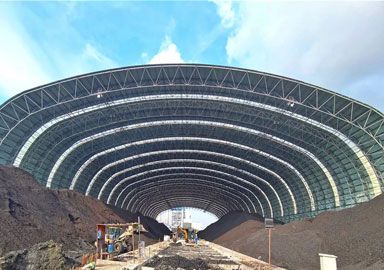
Long-span steel structures
Mining and processing plants
Port and logistics infrastructure
Energy and industrial EPC programs
In these environments, structural systems involve thousands of interfaces.
Small interpretation differences compound into system-level construction failure.
In large steel projects, the most expensive risk is rarely fabrication quality.
It is uncontrolled execution interpretation across teams and regions — a risk fully mitigated by LF’s industrial steel structure subcontracting solutions.
Copyright © Xuzhou LF Engineering & Construction Co., Ltd. All Rights Reserved.


 +86 177 5198 6706
 +86-516-8595-0258


