

+86 177 5198 6706
222, Block B, Diamond International, Guozhuang Road, Xuzhou, Jiangsu, China
From the futuristic architectural styles of the 1960s to today’s eclectic designs, airport terminals around the world have become another key factor influencing travelers’ choices. Let’s take a look at five airports with exceptional design.
1. Chhatrapati Shivaji International Airport, Mumbai, India
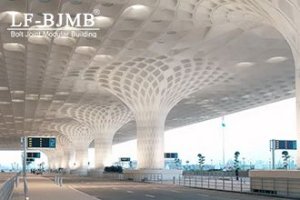
Designed by SOM, Mumbai’s new Terminal 2 rose from the ground to showcase the history and traditions of Mumbai and India within a modern setting and with state-of-the-art facilities. The spatial layout and structure blend seamlessly with the terminal as a whole, from the columns on the top floor and the articulated lattice panels on the roof to the lattice windows that allow sunlight to flood the halls like starlight.
Inspired by traditional Indian pavilion architecture, this four-story terminal features a grand “penthouse,” or central processing platform, beneath which lie versatile, fully equipped concourses. Rather than being compartmentalized, these concourses radiate outward from the central processing core, allowing passengers to move freely between international and domestic flights.
Upon entering the terminal, passengers step into a warm, bright space where a row of multi-tiered columns supports a wide-span roof. The vast space created by 30 tall columns beneath the roof evokes the aerial pavilions and inner courtyards found in traditional regional architecture. Sunlight filters through stained-glass panels embedded in the ceiling latticework, casting a dappled glow across the hall. The vibrant colors evoke the airport’s emblem—the peacock, India’s national bird.
2. Beijing Daxing International Airport, China
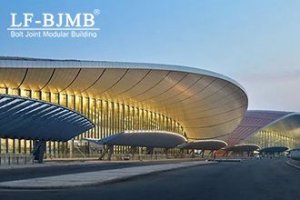
Located in Daxing District, Beijing, Beijing Daxing International Airport features a terminal building spanning 700,000 square meters, including an 80,000-square-meter ground transportation hub.
The multi-level atrium at the center of the terminal directs large numbers of passengers to their respective departure, arrival, and transfer areas. The fluid forms beneath the terminal’s arched roof extend to the ground level, forming six concourses. These structures not only provide structural support but also guide passengers toward the central hub while allowing ample natural light to enter.
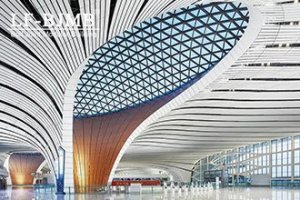
A linear skylight grid allows natural light from outside to enter the interior, serving as a wayfinding element to guide passengers to their respective gates. The terminal’s structural span of over 100 meters provides the airport with spacious public areas while maximizing flexibility for future layout adjustments.
3. Queen Alia International Airport, Amman, Jordan
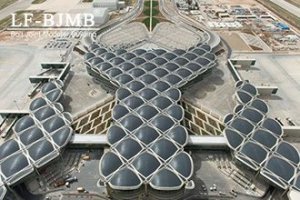
The building is constructed entirely of concrete, utilizing the material’s high “thermal mass” properties to achieve passive environmental control. The checkerboard-patterned roof comprises a series of shallow concrete domes that extend outward to provide facade shading. To facilitate seamless future expansion, each dome is designed as a modular unit.
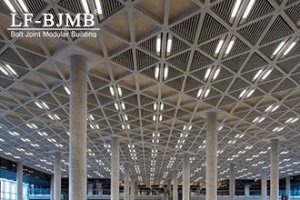
The domes branch out from the supporting columns like the fronds of a desert palm tree, while sunlight pours into the airport concourse through the openings at the column junctions. Geometric patterns based on traditional Islamic forms are applied to each exposed vault, echoing the textural veins of palm fronds.
4. Madrid Barajas Airport, Spain
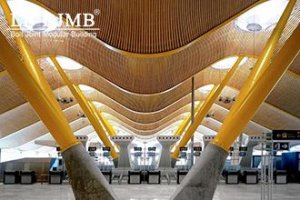
Terminal 4 of Madrid Barajas Airport was designed by the renowned British High-Tech architect Richard Rogers Partnership.
The new terminal’s massive roof features a continuous wave-like form, supported by numerous giant “Y”-shaped steel columns. The surrounding walls consist of massive floor-to-ceiling glass panels, while the roof features numerous circular glass skylights, creating a ceiling that undulates like waves.
Decorated with long strips of fire-retardant bamboo, the main color scheme of the hall is beige. This design not only makes full use of natural light to conserve energy but also creates a soft, pleasing ambiance, embodying the architect’s philosophy of harmony between humanity and nature.
5. Bangkok Suvarnabhumi Airport Passenger Terminal
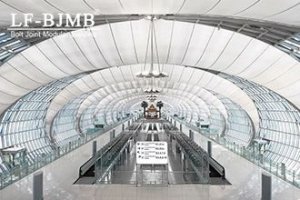
Bangkok Suvarnabhumi Airport was designed by German architect Helmut Jahn and built on green fields 24 kilometers east of Bangkok. The design prioritizes technical rationality, achieving a high degree of integration between land-side transportation, terminal design, and air-side organization, resulting in a compact and efficient master plan for the airport.
The large grid-structured roof spanning the functionally independent building complex unifies the site’s form and defines the main architectural silhouette as viewed from the land side. The outdoor spaces between the buildings are shaded by the roof grid, and elements of local culture and traditional architecture are incorporated into the landscaped courtyards.
Copyright © Xuzhou LF Engineering & Construction Co., Ltd. All Rights Reserved.


 +86 177 5198 6706
 +86-516-8595-0258


