

+86 177 5198 6706
222, Block B, Diamond International, Guozhuang Road, Xuzhou, Jiangsu, China
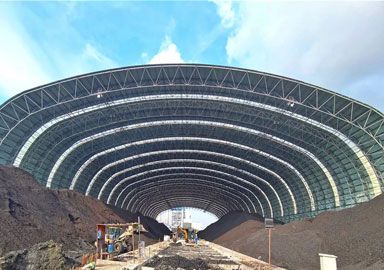
Space frame structures — double-layer cylindrical and spherical grid shells — are the most economical way to cover coal storage spans of 50 to 150 meters without intermediate columns. They enclose power plant, port and steel mill yards completely, meet environmental dust-control requirements, and can be erected while the yard below keeps operating.
A coal yard is not a gentle environment. The shed must span the stacking area and the reclaiming equipment, and leave clearance for bucket-wheel stackers and reclaimers to move and rotate. It must also resist the lateral pressure of the coal pile itself and enclose the yard completely to stop dust escaping.
Spans commonly range from 50 to 120 meters for cylindrical (barrel) sheds, and beyond 100 meters for dome storage. Inside, ventilation, dust control, lighting and fire protection all have to coexist with the structure.
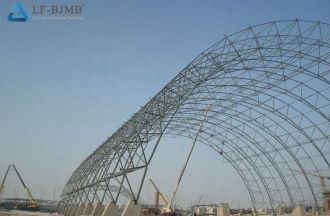
For enclosed coal storage, the most economical choices are double-layer grid shells: cylindrical grid shells for long, narrow yards and spherical (dome) grid shells for compact footprints. For spans of 50 to 120 meters, or even 150 meters, these systems are well proven. The main node types are:
The grid shell is supported along the base, usually on reinforced concrete walls or columns. The depth of the shell and the grid size are optimized against the span, the coal pile height and the local loads.
Coal pile pressure. The stored coal exerts lateral pressure on the lower part of the shed. The height of the pile must be coordinated with the structural profile.
Wind and snow. Large curved roofs are sensitive to wind uplift and to uneven snow distribution caused by wind-driven snow migration. Design considers full-span, partial-span and half-span snow layouts.
Temperature effects. Long sheds and large domes expand and contract with temperature. Supports and structural joints must accommodate the movement.
Ventilation and dust control. The enclosure integrates ventilation openings, dust-collection points and natural lighting strips that keep the yard workable.
Fire protection. Coal dust and coal self-heating are real hazards. Fire-protective coatings and fire zones are designed according to the project fire class.
Corrosion protection. Coastal power plants demand heavy-duty coating systems or hot-dip galvanizing for the members.
Large coal sheds are erected with the same logic as other long-span roofs, adapted to the site. High-altitude sliding assembles segments at one end and slides them along rails, reducing scaffolding to a minimum. Ground assembly with lifting builds dome segments at ground level and lifts them into place, minimizing work at height.
Cantilever and mini-crane methods erect domes ring by ring, with small cranes working on the finished shell; this is economical and avoids large lifting equipment. Because the yard below may already be in operation, construction sequencing is planned around the stacker-reclaimer. Working areas are isolated, and the roof is closed progressively so that dust control can start early.
Q: What spans can space frame coal storage sheds achieve?
A:Cylindrical grid shells typically span 50 to 120 meters, and dome sheds can exceed 100 meters. Double-layer systems reach about 150 meters. The choice depends on yard shape and stacking capacity.
Q: Which is better for coal storage, a dome or a cylindrical shed?
A:Cylindrical shells suit long, narrow yards, while domes suit compact footprints. Both are double-layer grid shells with bolt ball or welded ball nodes. LF-BJMB has delivered dome coal sheds over 100 meters.
Q: How much does a coal storage shed cost?
A:Cost depends mainly on span, height, coating system and site conditions. Cylindrical shells are generally the most economical for spans of 50 to 120 meters. Contact LF-BJMB for a free program proposal with budget figures.
Copyright © Xuzhou LF Engineering & Construction Co., Ltd. All Rights Reserved.


 +86 177 5198 6706
 +86-516-8595-0258


