

+86 177 5198 6706
222, Block B, Diamond International, Guozhuang Road, Xuzhou, Jiangsu, China
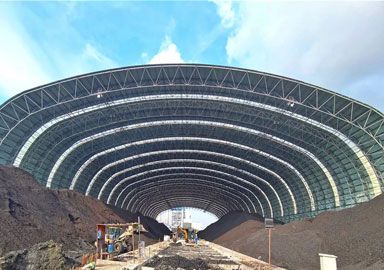
Most coal storage sheds are built while the plant keeps receiving coal. For bulk storage facilities next to a running plant, the erection plan is the main schedule risk.For an owner, general contractor or consulting engineer, the erection plan is not a detail — it is the main schedule risk. Prefabricated space frame segments, sliding and hoisting over operating areas keep coal handling on line while the roof goes up around them, and the method you choose decides whether the project opens on time.
On a greenfield site the whole yard is empty. On a running power plant, trucks, stacker-reclaimers and conveyor lines keep working through the project, and any mistake in the lift plan can cut fuel supply to the units. The new roof therefore has to be built around these live lines rather than over a clean site.
For a project team, this means the construction plan and the coal handling plan must be one document. Possession windows, exclusion zones and night lifts are agreed weeks in advance with the plant operators, not decided on the construction site.
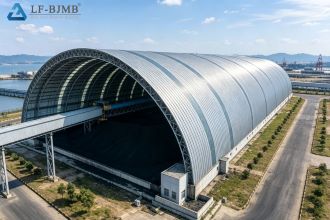
Three methods dominate barrel coal shed erection, and each suits a different site layout:
Segmental hoisting.A crane lifts preassembled space frame segments into place during short possession windows. This is the most flexible method for compact sites and irregular yards.
Integral lifting.A whole roof section is assembled flat on the ground and raised in one move, which cuts work at height and suits compact sheds.
The grid is pushed along rails on the yard edge, ideal for long, straight barrel sheds where the whole bay can be built at ground level.
Ground assembly with lifting.Most of the grid is bolted together at ground level first, then lifted or placed — the standard way to keep height work to a minimum.
Each method keeps most work on the ground, away from the operating stacker-reclaimer and live conveyor lines.
A running coal yard has no free corners. The erection sequence is planned against the stacker-reclaimer cycle, not against the construction calendar:
Lifts are scheduled when the stacker is on the other side of the yard, with clearance checked before every lift.
Exclusion zones are marked and guarded around live belts and the reclaiming point.
Night and weekend possession windows are used for the heaviest lifts, so daytime coal handling is undisturbed.
Materials and crane positions are staged so they never block truck roads or the conveyor gallery.
The roof is closed bay by bay. The plant can receive coal under one completed bay while the next bay is still being erected, so fuel supply never stops.
Once a bay is weathertight, cladding, ventilation and interior work proceed under cover. This early roof protection is how the project hands over on schedule even though the plant never shuts down.
Working next to running conveyors means fall protection, lift planning and daily toolbox talks are standard. All welding and hot work near live equipment is isolated and supervised, and the site is kept clean enough that coal fines cannot interfere with lifts or equipment.
Q: How is a coal shed built without stopping the plant?
A:The space frame grid is prefabricated off site and delivered as numbered kits. It is erected in segments by hoisting, integral lifting or sliding, with most work done on the ground during agreed possession windows. Bays are closed one by one, so coal handling continues throughout.
Q: Which erection method suits an operating yard best?
A:Short possession windows favour segmental hoisting; a long straight barrel shed favours sliding; a compact shed often uses integral lifting. The method is chosen after walking the operating site and agreeing the possession schedule with the plant team.
Q: Does enclosing the yard reduce dust control work afterwards?
A:Yes — an enclosed shed needs less water spraying and fixed extraction. More on that in our guide on why fully enclosed raw material yards matter.
Erection planning decides whether a coal storage project opens on time. LF-BJMB designs and erects bolted space frame barrel coal sheds around operating power plants, coordinating the lift plan, possession windows and phased handover from the first layout. We provide free program proposals and method statements for new projects. For more project cases, visit our news center.
Copyright © Xuzhou LF Engineering & Construction Co., Ltd. All Rights Reserved.


 +86 177 5198 6706
 +86-516-8595-0258


