

+86 177 5198 6706
222, Block B, Diamond International, Guozhuang Road, Xuzhou, Jiangsu, China
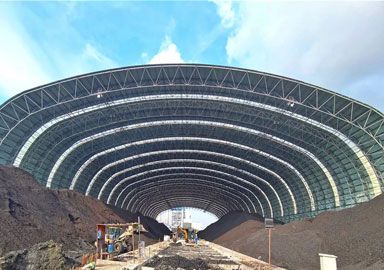
A large-span bulk storage shed is a fully covered stockpile building that keeps coal, ore, aggregate, clinker, grain or other dry bulk under one roof. It replaces open stockyards that lose material to rain, wind and dust. For a power plant, mine, cement plant or port terminal, the question is not whether to cover the stockpile — it is what span, shape and handling equipment fit the material inside.
Open stockyards lose product every season: rain washes fines away, wind carries dust onto the surrounding site, and exposed material degrades in quality. A covered bulk storage shed solves all three problems at once. It also lets loading and reclaiming equipment work in any weather, which matters on a port terminal where ships must load on schedule.
The same building appears in several settings: a coal shed beside a power plant, an ore or aggregate shed at a mine or quarry, a clinker shed at a cement plant, and a bulk cargo shed at a deep-water port. The building concept is similar, but the structural system and internal layout still depend on the material, stockpile geometry and handling equipment.
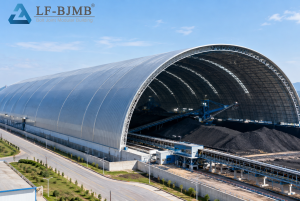
The shape and span of the shed follow the material and the reclaiming equipment. Common applications include:
Coal storage shedsfor power plants, covering stockpiles up to 120 meters
Ore and concentrate shedsat mines and processing plants.
Aggregate and sand shedsat quarries and concrete batching plants.
Cement clinker and raw meal shedsat cement plants.
Grain and fertilizer shedswhere moisture and weather protection are critical.
Port bulk cargo shedsat deep-water terminals, where ships, trucks and belt conveyors meet under one roof.
Bulk storage sheds use barrel arch or curved space frame roofs, because the material inside needs a column-free floor for stackers, reclaimers and trucks. A space frame is often considered for spans in the 30–120 meter range, especially where a column-free floor is required. Compared with conventional portal frames, it can be more suitable for very large clear spans.
Members arrive as numbered kits in standard containers, connected by bolted ball nodes. The grid is assembled at ground level and lifted or slid into place, which keeps work at height to a minimum. Because the system is modular, the shed can be extended bay by bay as the stockpile grows.
For overseas projects, the decision is not only about fabrication capacity. Shipping dimensions, container loading, site assembly and local erection capability also affect the final solution. Importing from Europe adds cost and lead time. A bolted space frame from an export-oriented factory sits between the two: mill-rated steel, containerized delivery and supervised erection by local crews.
For a port or industrial zone project, the same supplier also covers the buildings around the shed — the cargo warehouse, the equipment workshop and the conveyor gallery. One package means the port authority or EPC contractor manages one interface, not several.
Column-free floor— reclaimers, stackers and trucks move without columns in the way.
Containerized kits— members fit standard sea containers to the nearest port.
Local crew erection— no welding crew is needed on site.
One package— storage shed, warehouse, workshop and gallery under one contract.
Q: What is the largest span a bulk storage shed can cover without columns?
A:Bolted space frame barrel arches commonly cover 30 to 120 meters clear, which leaves reclaimers and stackers free to move along the wall.
Q: Can the shed be extended later?
A:Yes. The roof is built in repeatable bays, so an extension is added bay by bay without rebuilding the existing shed.
Q:: How is a large storage shed erected on site?
A:Members are bolted to ball nodes at ground level, then lifted or slid into position as one grid. Local crews do the bolting under our supervision, with no welding crew required.
Bulk storage sheds are the practical alternative to open stockyards: they protect material, control dust and let handling equipment work in any weather. For power plants, mines and port terminals, the shed is the building that ties the whole site together.
If you are planning a new storage shed or a port bulk handling facility, send us your stockpile size and the handling equipment. We will return a span-and-bay scheme and a containerized delivery plan. For more project cases, visit our news center.
Copyright © Xuzhou LF Engineering & Construction Co., Ltd. All Rights Reserved.


 +86 177 5198 6706
 +86-516-8595-0258


