

+86 177 5193 6871
222, Block B, Diamond International, Guozhuang Road, Xuzhou, Jiangsu, China
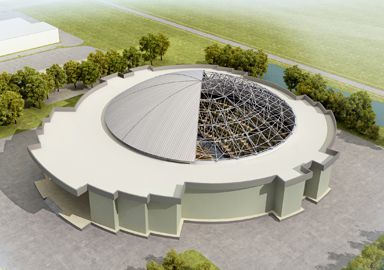
Long-span steel structures are widely used in buildings such as sports stadiums and airport terminals, but their design and construction face the dual challenges of “stability” and “durability.” When the length of a steel truss exceeds 60 meters, it is prone to bending and deformation due to uneven stress distribution. During strong winds, the structure may sway continuously, leading to damage over time. In the event of an earthquake, if the truss connections are not sufficiently robust, they may even break completely. Therefore, whether estimating the impact of high winds, designing seismic resistance measures, or conducting routine inspections, every step must be carried out meticulously to ensure the steel structure remains stable and problem-free.
1. Structural Stability Challenges
The stability risks of long-span steel structures primarily manifest in the following ways: ① Component buckling—slender steel purlins are prone to lateral instability due to excessive spacing and applied loads; ② Global deformation—improper support arrangements in spatial grid shells can result in excessive deflection under self-weight and snow loads; ③ Vibration damage—vortex-induced vibrations triggered by strong winds can cause fatigue in steel components.
Risks during the construction phase include: improper placement of lifting points for heavy steel trusses can lead to deformation, and incorrect removal sequences for temporary supports during high-altitude assembly can trigger stress redistribution, threatening structural safety.
2. Reinforcement and Optimization
The stability of steel structures can be significantly enhanced through prestressing technology, optimized joint design, and a “rigid-flexible” bracing system. In the design of long-span steel trusses, external prestressing cables can counteract internal forces and reduce deflection. For example, in an 80-meter-span sports arena steel truss, the deflection was reduced from 150 mm to 80 mm after installing prestressing cables. In terms of joint design, semi-rigid joints enhance rotational capacity, improving the structure’s seismic and wind resistance; stiffeners at critical joints prevent stress concentration. For instance, after optimization, the shear capacity of a super-high-rise steel column-beam joint increased by 30%. The bracing system adopts a “combination of rigidity and flexibility”: the main structure’s rigid bracing ensures stability, while the secondary structure’s flexible cables distribute loads, saving materials and accommodating deformation to prevent cracking.

3. Seismic Design
The effectiveness of a steel structure’s seismic resistance ultimately depends on the materials and connection methods. Using “ductile” steels such as Q355ND and Q460GJ allows the structure to deform like a spring during an earthquake, absorbing energy and preventing sudden fractures. For example, in an earthquake-prone region, a factory building constructed with Q460GJ steel sustained only minor deformation after an earthquake and remained largely undamaged.
The connection method is also particularly important. Connections secured by high-strength bolts through friction are more “resilient” than ordinary welding; during an earthquake, slight bolt slippage can help dissipate some of the impact force. Installing “shock-absorbing marvels” like friction dampers or viscous dampers at critical joints yields even better results. After installing these in a steel-structured office building, the amplitude of sway during an earthquake was reduced by 40%.
4. Wind Load Reliability
How do we assess the reliability of a steel structure during extreme wind conditions? We can use a “probability calculation + modeling” approach. First, we collect local high-wind data from the past 50 years to calculate the probability of a super-strong wind event (such as a once-in-a-century storm). Then, we use specialized software to simulate the swaying and stress conditions of the steel structure in high winds to determine if it will collapse.
Some steel structures are particularly prone to swaying in high winds, so wind tunnel testing is necessary. A 1:50 scale model of the steel structure is placed in a wind tunnel to simulate winds of varying directions and intensities, observing the model’s swaying frequency and amplitude. Based on the test results, the structure’s shape can be optimized (e.g., designed with a streamlined profile that minimizes wind catch) or wind-bracing cables can be installed to prevent the structure from swaying into a “resonant” state that could cause it to collapse.
Improving the reliability of steel structure design relies on the synergy of materials, technology, and monitoring. By optimizing support systems and using high-performance steel, combined with scientific wind load assessments and intelligent monitoring, we reinforce structural safety at every level. This helps large-span steel structures break through spatial limitations and achieve long-term stability in extreme environments.
Frequently Asked Questions (FAQ)
Why are large-span steel structures prone to deformation?
As the span of a structure increases, so do the length of the components and the range of forces acting on them. If structural stiffness is insufficient or load distribution is uneven, significant deflection or deformation can easily occur. Therefore, design typically requires controlling deformation by adding support systems or employing prestressing techniques.
Are steel structures safe during earthquakes?
Steel structures possess excellent ductility and can absorb energy through plastic deformation under seismic loads, resulting in good seismic performance. However, their safety still depends on material selection, connection methods, and overall structural design.
Why are wind tunnel tests required for large-scale buildings?
For large-scale structures such as sports stadiums and airport terminals, wind loads are complex. Wind tunnel tests simulate real-world wind conditions, allowing for the analysis of structural forces under varying wind speeds and directions, thereby optimizing the structural design.
Copyright © Xuzhou LF Engineering & Construction Co., Ltd. All Rights Reserved.


 +86-17751936871
 +86-516-8595-0258


