

+86 177 5198 6706
222, Block B, Diamond International, Guozhuang Road, Xuzhou, Jiangsu, China
Steel structures in humid and coastal environments face a practical problem: moisture can remain trapped around connections, beneath roof cladding and inside poorly drained details. Salt and industrial pollutants can make the problem worse. These conditions need to be considered when selecting the corrosion protection system, particularly for buildings that are difficult to access for maintenance. A structure with generous sections but poor drainage will deteriorate years before a lighter one with well-detailed connections and a properly specified coating. Understanding which of these factors is controlling on a given site is what allows an owner to specify protection that matches the actual exposure rather than guessing.
Steel does not corrode because the air is humid. It corrodes because moisture sits on the surface long enough for the electrochemical reaction to proceed. In a temperate climate, rain runs off and surfaces dry within hours. In a tropical or coastal-humid climate, relative humidity may remain above the critical threshold for most of the year, so surfaces stay damp between rain events and the reaction never fully stops.
This is why the same coating system can perform very differently in two locations without either specification being wrong. It is also why the practical question is not “how humid is it” but “how long does the surface stay wet”.
Airborne chloride. Near a coast, sea spray carries salt inland several kilometres. Salt is hygroscopic: it pulls moisture out of the air and holds it against the steel long after the surrounding surface would otherwise have dried. This is the single largest accelerator of corrosion on coastal sites, and it is why exposure categories distinguish between onshore, near-shore and splash-zone conditions.
Time of wetness.Sheltered faces, undersides of roofs, the interior of closed boxes and the gaps between two plates all stay damp longer than exposed faces. A structure that looks uniformly protected in a photograph often has a few locations where the coating is under continuous attack.
Temperature cycling.Daily heating and cooling pulls moisture into and out of joints. Where the cycle is strong and the detail traps water, the movement accelerates coating breakdown at exactly the point where repair is hardest.
Corrosion damage is rarely spread evenly across a structure. It concentrates at details, and the reason is geometric rather than metallurgical.
Welded joints. A welded joint damages the coating over a zone that cannot be properly re-treated on site. The heat-affected area is left with a thinner or discontinuous protection layer, and in a humid climate that is where rust begins.
Bolted interfaces and crevices. Two surfaces bolted together form a crevice. Water enters, oxygen is consumed inside, and the environment in the gap becomes more aggressive than the exposed surface nearby. The gap also holds moisture long after the rest of the member has dried.
Cut ends and drilled holes. The cut end of a galvanized member exposes bare steel. If it is left unsealed, corrosion proceeds from the inside of the section outward, and the visible surface gives no warning until the damage is advanced.
Roof and wall interfaces. Where cladding meets structure, water collects unless the flashing is detailed to shed it. This is frequently the first place an owner notices a problem.
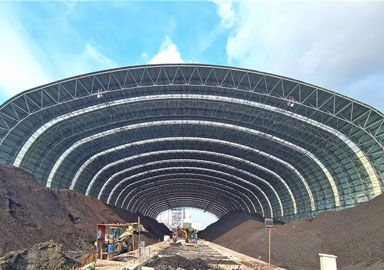
A bolted space frame is often described in terms of erection speed, but in a humid climate it offers a durability advantage that is at least as significant. Because the connections are mechanical, members and nodes can be fully galvanized or coated in the factory, where surface preparation and coating thickness can be controlled and inspected. On site, the structure is assembled without welding, so the protective layer is never opened up by heat.
The advantage is conditional, not automatic. The bolted connection has to be detailed so that water drains rather than collects, and the bolt assemblies themselves need a specification suited to the exposure. A bolted system assembled without attention to those details simply relocates the problem from the weld to the crevice.
For an owner or engineer preparing a project, three items decide the outcome and should be settled before bids are invited, because they drive both price and maintenance planning:
Exposure Conditions.Identify the applicable environmental exposure category using the relevant project standard. Consider coastal salt exposure, industrial pollution, moisture retention and the accessibility of the structure for inspection and maintenance.
Protection system and thickness. Hot-dip galvanizing with a stated coating mass, a multi-coat paint system, or a duplex combination. What matters for comparison is that the specification states the thickness and the test method, so two bids can be assessed on the same basis.
Maintenance assumption. If the owner assumes no inspection for ten years, the initial protection must carry that period. If access for repainting is impossible — over a stockpile, for example — the whole-life protection has to be built in from the start.
Q: Is hot-dip galvanizing sufficient on its own?
A: For moderate exposure it often is. On a shoreline site or where the structure will not be accessible for maintenance, a duplex system of galvanizing plus a topcoat usually gives a better whole-life result. The decision should follow the stated exposure category, not a default.
Q: Does humidity affect the structural design as well as the coating?
A: Yes. Humid and coastal sites generally carry higher basic wind pressures, and the same conditions argue for details that drain, ventilate and avoid pockets where water can collect. The structural scheme and the protection system are better decided together.
In a humid climate, service life is set by exposure, detailing and coating thickness rather than by the amount of steel in the structure. Fixing those three items at the specification stage costs far less than discovering the gap at the first inspection.
LF-BJMB reviews exposure conditions alongside the structural scheme in preliminary assessments, so that the protection system and the frame are specified together rather than in sequence.For project references, see our solutions page.
Copyright © Xuzhou LF Engineering & Construction Co., Ltd. All Rights Reserved.


 +86 177 5198 6706
 +86-516-8595-0258


