

+86 177 5198 6706
222, Block B, Diamond International, Guozhuang Road, Xuzhou, Jiangsu, China
The span of a coal storage silo cannot be determined based on guesswork alone.
In actual engineering projects, it is primarily constrained by five factors: storage capacity, site dimensions, on-site equipment, wind and snow loads, and the investment budget.
Next, LFBJMB will break down these five factors to help you determine the appropriate span for your project. If you have any questions, please feel free to contact LFBJMB.
The size of the storage capacity directly determines how large the storage area needs to be.
When the site length is fixed, the larger the storage capacity, the more you’ll need to increase the span to gain floor area.
For projects in the tens of thousands of metric tons range, medium-to-small spans of 30–60 meters are usually sufficient; for projects in the hundreds of thousands of metric tons range, such as those at ports or energy hubs, column-free spans of over 100 meters are often required.
Simply put: if storage capacity is limited, the span cannot be very large.
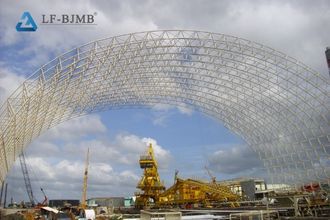
No matter how ideal the span may be, it must still fit within the site.
The site’s property lines, shape, and existing surrounding structures directly dictate the maximum size you can build.
Rectangular plots are suitable for long spans running along the length of the site; for square or irregular plots, spans must be more conservative.
In industrial zones where land is scarce and factory buildings flank both sides, extremely large spans simply cannot be accommodated; you can only choose the most cost-effective option within the permitted limits.
The span must be designed to accommodate the equipment operating within the warehouse.
The turning radius and travel width of stacker-reclaimers, plus safety clearances, determine the minimum clear span.
For example, a stacker-reclaimer with a boom length of about 40 meters typically requires a span significantly greater than the boom length to allow for full rotation without interference.
The larger the equipment, the greater the required span—this is a hard constraint that cannot be compromised.
The larger the span, the more wind the roof captures and the more snow it accumulates, resulting in heavier structural loads.
In typhoon-prone areas, regions with high snow loads, and high seismic resistance zones (as defined by GB 50011, “Code for Seismic Design of Buildings”), the requirements for the cross-sections and joints of large-span structures are even more stringent.
In areas with harsh load conditions, do not force an excessively large span; either allocate additional funds for reinforcement or reduce the span.
There can be no compromise when it comes to wind and snow loads.
The first four items establish the “lower limit,” while the budget sets the “upper limit.”
With each increase in span category, costs for steel, design, and construction rise accordingly.
For demonstration projects and major ports with ample budgets, ultra-long spans can be adopted to maximize efficiency and operational convenience;
For renovation projects or conventional plants with tight budgets, selecting industry-standard spans is a safer choice—aim for what is sufficient rather than spending unnecessarily on extra space.
Common Span Ranges Corresponding to Different Storage Capacities (for reference only; actual design specifications prevail):
| Project Type | Storage Capacity Range | Common Span |
| Small Coal Storage Yard | Tens of thousands of metric tons | 30–60 meters |
| Medium-Sized Industrial Coal Storage | 100,000-metric-ton class | 60–90 meters |
| Large Ports / Energy Hubs | Hundreds of thousands of metric tons and above | 100 meters and above (column-free) |
There is no such thing as a “standard span” for coal storage silos. To determine the span, first lock in the storage capacity and equipment—these are the absolute minimums;
then assess the available site area and whether the local load-bearing capacity can support it;
finally, finalize the design based on the budget.
Of these five factors, the budget and span most often conflict. Ensure safety and adequate capacity first, then consider spaciousness.
Frequently Asked Questions (FAQ)
Q1: What criteria should take priority when determining the span of a coal storage silo?
A: First, determine a minimum span based on storage capacity and equipment; then assess how much the site can be expanded; finally, finalize the design based on the budget and load-bearing capacity.
Q2: Why does equipment affect the span of a coal storage silo?
A: The span must exceed the maximum operating width of the equipment to allow sufficient space for turning and maintenance; otherwise, the machinery won’t be able to maneuver inside.
Q3: Can an extra-large span be built in areas with poor load-bearing conditions?
A: It is possible, but the structural members must be reinforced and the joints strengthened, which significantly increases costs. Generally, it is not recommended to force a large span in areas with poor load-bearing conditions.
Q4: How should the span be selected when the budget is limited?
A: First, ensure that the three requirements—storage capacity, equipment, and safety—are met. Then, selecting a standard span is sufficient; don’t spend extra money just to make it “bigger.”
Copyright © Xuzhou LF Engineering & Construction Co., Ltd. All Rights Reserved.


 +86 177 5198 6706
 +86-516-8595-0258


