In
coal storage project construction, the building span of the coal storage silo is a core parameter determining the storage capacity of the yard, the operating efficiency of mechanical equipment, site utilization, and overall investment cost. It is also a key focus for owners, procurement, and engineering design phases.
Most project developers will inquire about the maximum applicable span of the coal storage silo, the economically reasonable span specifications, and the standardized design principles for large-span coal storage silos. This article, based on industry-standard engineering experience, systematically explains the common span ranges, applicable scenarios, selection logic, and design principles for large-span structures of coal storage silos.
1. What is the span of a coal storage silo?
The span of a coal storage silo refers to the horizontal clearance between the main supporting structures on both sides of the building. Simply put, it is the effective passage and stacking width inside the coal storage silo without obstructions from columns. Span is a key indicator determining the performance of coal storage silos. Within a reasonable design range, a larger span provides more internal space, allowing for greater operational freedom of large stacking, reclaiming, and loading equipment. This also increases overall material storage capacity and site utilization, making it more suitable for modern, mechanized, and large-scale coal storage operations.
2. Typical Span Ranges and Applicable Scenarios for Coal Storage Silos
Based on domestic industrial project implementation experience, coal storage silo spans can be divided into four mainstream ranges to suit the storage needs of different scales and industries.
30 to 50 meters is considered a small, standard span. Its simple structure and economical cost make it suitable for small to medium-sized industrial storage scenarios. It is widely used in small coal storage yards, cement plants, and various small and medium-sized factory coal storage projects, meeting basic material turnover storage needs.
50 to 80 meters is currently the most widely used mainstream span range in the industry, achieving a high balance between structural safety, spatial practicality, and construction economy. It is highly versatile and primarily suitable for conventional industrial coal storage projects such as thermal power plants, steel enterprises, and large industrial parks, meeting the needs of conventional mechanized stacking and reclaiming operations.
80 to 120 meters is a large span specification, with greater structural load-bearing capacity and spatial volume, suitable for large-scale storage scenarios. It is widely implemented in large coal storage bases, port bulk material yards, and specialized bulk material storage centers—projects requiring large storage capacity and high turnover.
Spans exceeding 120 meters are designed for ultra-large span coal storage silos, demanding extremely high standards in structural design, construction technology, and load calculation. They are mainly used in key projects such as large coastal ports, centralized large-scale coal storage centers, and national-level energy storage and transportation projects, meeting the high-end needs of ultra-large storage capacity and integrated centralized storage.
3. The Core Reasons for the Rise of Large-Span Coal Storage Bunkers in the Industry
Currently, an increasing number of industrial coal storage projects prioritize large-span designs, with core advantages concentrated in two dimensions: efficiency and long-term operational benefits.
Large-span coal storage bunkers allow for a pillar-free internal layout, completely eliminating the occupation of storage space by columns, significantly improving overall storage space utilization, and maximizing the release of site storage area.
Simultaneously, the open and unobstructed internal space can fully accommodate the flexible operation of large loaders, automated stacker-reclaimers, and conveyor systems, avoiding equipment scratches and operational limitations, effectively improving operational efficiency.
During long-term operation, the large-span layout reduces maintenance losses caused by equipment interference, simplifies on-site management processes, reduces labor and equipment operating costs, and offers greater site layout flexibility, reserving ample adjustment space for future capacity expansion, process optimization, and equipment upgrades, resulting in stronger project adaptability and scalability.
4. Key Influencing Factors in Coal Storage Bunker Span Design
The span of a coal storage bunker is not arbitrarily selected; it must be comprehensively assessed and designed based on the actual conditions of the project.
First, storage capacity requirements: the total planned coal storage volume and material turnover days directly determine the required space size of the storage yard, forming the basis for span selection.
Second, site conditions: the site’s length and width dimensions, topography, and foundation bearing capacity constrain the upper limit of the span, ensuring the structural layout conforms to site conditions.
Simultaneously, the site equipment layout must be matched. Based on the stacker-reclaimer’s operating radius, equipment specifications, and conveyor line layout, a reasonable span is determined to ensure the normal operation of machinery.
Furthermore, meteorological and geological parameters such as wind load, snow load, and seismic intensity at the project site directly determine the structural stress standards; larger spans place higher demands on structural load-bearing capacity.
Finally, considering the project’s investment budget, a balance must be struck between span specifications, structural costs, and usage benefits to select the most economical and reasonable span scheme while meeting safety and operational requirements.
5. Safety Design Assurance for Large-Span Coal Storage Bunkers
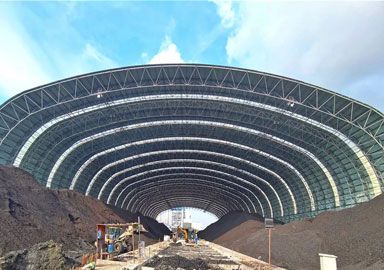
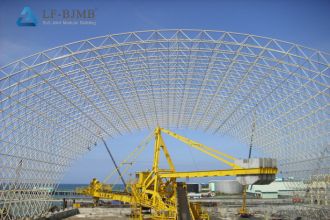
While large-span coal storage bunkers appear to have a larger spatial volume and higher design complexity, relying on mature modern spatial steel structure technology, they can achieve safe and stable long-term operation. Dome-shaped and arched spatial structural systems possess characteristics such as uniform stress distribution, strong overall stability, and excellent wind and earthquake resistance, effectively mitigating the stress risks of large-span structures and adapting to various complex climates and geological environments.
Meanwhile, the safe implementation of large-span coal storage silos relies on professional management throughout the entire process. Through precise load calculations, scientific structural system design, and refined node optimization, coupled with standardized, high-quality factory processing and on-site construction and installation, the structural strength, stability, and service life of large-span coal storage silos can be comprehensively guaranteed, meeting the long-term safe operation standards of industrial projects.
Conclusion
Span design is a core element of coal storage silo planning, directly determining the project’s storage capacity, operational efficiency, safety performance, and economic benefits. A scientifically sound large-span design can maximize storage space, optimize equipment operating conditions, and reduce long-term operating costs while ensuring structural safety and compliance.
With the upgrading of industrial warehousing towards large-scale, mechanized, and green operations, 30-meter to 150-meter full-size large-span enclosed coal storage silos have become the mainstream development direction for modern coal and bulk material storage projects.
Frequently Asked Questions (FAQ)
Q1: What is the maximum span of a coal storage silo?
A: Currently, mature construction technologies in the industry allow for the design and construction of coal storage silos with spans of 150 meters and above, fully meeting the construction needs of various ultra-large energy storage and transportation projects.
Q2: Is a larger span always better for coal storage silos?
A: Not necessarily. Ultra-large spans increase structural design and construction costs. The selection must be based on a comprehensive consideration of the project’s actual storage requirements, site conditions, and investment budget, balancing safety, practicality, and economy.
Q3: Will a large span design significantly increase construction costs?
A: A large span layout will slightly increase the amount of steel structure materials used and the difficulty of design and construction, but it can greatly improve site utilization and operational efficiency, reduce long-term operating costs, and result in better overall comprehensive benefits for large-scale projects.
Q4: Which structural forms are suitable for large-span coal storage silos?
A: Industry-standard cylindrical and domed coal storage silos can all be designed for large spans. The best option can be selected based on the project’s environmental requirements, site shape, and budget.
Q5: How to accurately determine the appropriate span for a coal storage silo for a project?
A: The optimal span specification needs to be determined by comparing professional solutions and performing structural calculations, taking into account the project’s planned storage capacity, site dimensions, mechanical equipment parameters, local load conditions, and investment budget.





 +86 177 5198 6706
 +86-516-8595-0258


