

+86 177 5198 6706
222, Block B, Diamond International, Guozhuang Road, Xuzhou, Jiangsu, China
During the construction phase of a coal storage project, the overall design of the coal storage shed directly determines the project’s structural safety, construction economy, and long-term operational efficiency. A scientifically sound coal storage shed design can not only fully meet the material storage capacity requirements but also effectively control initial construction investment, reduce material losses due to wind and rain, and ensure the smooth operation of various loading, unloading, and conveying equipment within the site. The following systematically outlines five core elements that must be carefully controlled during the coal storage shed design phase.
The primary prerequisite for coal storage shed design is clarifying the overall storage capacity plan for the project. In the early stages of design, it is necessary to clarify the total planned coal storage tonnage, the typical material turnover days, and assess the possibility of future capacity expansion in the plant area, reserving space for future expansion and adjustments. Common planned scales include coal storage yards with capacities of 20,000 tons, 50,000 tons, and 100,000 tons. The total material storage capacity directly determines the overall length, span, and eaves height of the coal storage shed, serving as the foundation for all subsequent architectural and structural designs.
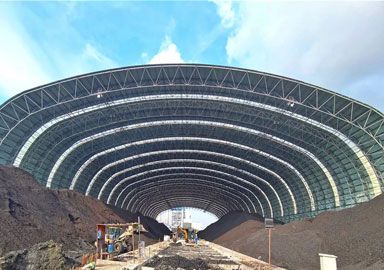
Building span is a key indicator affecting the efficiency of internal space utilization in coal storage sheds. Commonly used spans in the industry include 30 meters, 50 meters, 80 meters, and over 100 meters. A large-span, column-free layout provides ample space for large machinery such as stacker-reclaimers and loaders, facilitates the layout of the overall conveyor belt system, and simplifies daily on-site operation and maintenance. For ultra-large coal yard projects, a spatial steel structure system is generally chosen to achieve the ultra-large span.
Different regional meteorological and geological environments impose varying and stringent requirements on the structural design of coal storage sheds. During the design phase, corresponding load parameters need to be calculated item by item. Projects located in coastal areas or typhoon-prone regions require enhanced overall wind-resistant structural design. In northern, cold, and snow-covered areas, the roof’s snow load-bearing capacity needs to be improved. Storage yards located in seismic fortification zones must strictly adhere to local seismic intensity standards for structural reinforcement and joint strengthening design. Extreme high temperatures or sustained low temperatures also impose design constraints on material selection and structural expansion joints. Therefore, coal storage sheds require customized designs tailored to the specific conditions of the project site.
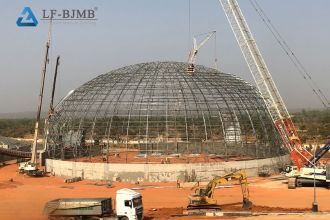
Different structural systems are suitable for different project positioning, budget standards, and environmental control levels. Spatial structure coal storage sheds offer advantages such as large span capacity, uniform overall stress distribution, high space utilization, and wide applicability. Dome-shaped coal storage sheds provide excellent sealing performance, outstanding dust control and environmental protection results, and strong architectural distinctiveness. Barrel-shaped coal storage sheds offer excellent cost-effectiveness, rapid construction, and convenient maintenance. Project owners need to comprehensively compare and select the final structural scheme based on their investment budget, local environmental control standards, and actual material storage operation needs.
Modern coal storage sheds are no longer simply material storage structures; they are also environmental protection facilities to meet dust control requirements. The design phase requires simultaneous planning of natural ventilation channels and mechanical forced ventilation systems, along with on-site dust removal devices, sprinkler dust suppression systems, and lighting infrastructure. A systematic ventilation and dust suppression design can effectively reduce dust concentration inside the shed, optimize the on-site working environment, avoid safety hazards caused by dust accumulation, and ensure that the overall project meets local environmental emission acceptance standards.
For coal storage projects, large-span designs offer multiple practical advantages. A column-free layout maximizes the effective material storage area, improves overall space utilization, eliminates interference from obstacles on loaders, stacker-reclaimers, and belt conveyor systems, significantly improves loading and unloading efficiency, reduces long-term operating costs, and offers greater flexibility in overall layout. This makes subsequent capacity expansion and process adjustments easier, enhancing project adaptability.
A standardized and complete coal storage shed design process consists of ten steps. First, it involves identifying basic project requirements and calculating material storage capacity. Next, it includes drafting the overall architectural plan, selecting the structural form, calculating load values for wind, snow, and earthquakes, designing the main structural load, and refining the design of key connection nodes. Following this, it involves designing the roof, walls, and enclosure system, preparing formal construction drawings, and finally, connecting the factory component fabrication with on-site assembly and installation. This standardized design process comprehensively ensures the structural safety and stability of the project while considering the rationality of construction investment.
Coal storage shed design is a comprehensive engineering task involving multiple disciplines. It requires a holistic approach, considering storage capacity requirements, structural safety and stability, environmental compliance, and operational practicality. A scientifically rigorous preliminary design can effectively control overall construction costs, maximize storage efficiency, extend facility lifespan, and improve long-term overall returns. For coal-related industries such as thermal power, steel, cement, and port storage and transportation, proper planning and structural selection of coal storage sheds are crucial for the smooth implementation and long-term operation of bulk material storage projects.
A: A larger span does not necessarily mean better overall benefits. Span selection must be based on a comprehensive consideration of the project’s actual coal storage scale, on-site equipment layout, and overall investment budget. Selecting the appropriate span based on actual needs is the most reasonable approach.
A: The height of the coal storage shed is mainly determined by a comprehensive calculation based on the maximum designed coal stacking height, the safety margin for mechanical equipment operation, and the project’s planned storage capacity.
A: Spatial structures have a mature and stable load-bearing system, excellent adaptability to large spans, and high space utilization, making them the mainstream structural form for various large coal storage shed projects.
A: In addition to improving the wind resistance design level of the structure, coastal areas require targeted strengthening of the anti-corrosion design of the steel structure to resist sea salt spray corrosion and ensure the long-term safety and stability of the structure.
A: With the continuous tightening of domestic environmental protection standards, fully enclosed coal storage sheds have become the industry mainstream, and the enclosed renovation of existing open-pit coal yards is also a common way to upgrade industrial environmental protection.
Copyright © Xuzhou LF Engineering & Construction Co., Ltd. All Rights Reserved.


 +86 177 5198 6706
 +86-516-8595-0258


