

+86 177 5198 6706
222, Block B, Diamond International, Guozhuang Road, Xuzhou, Jiangsu, China
In some mine projects, RFQs are issued before the structural scope is fully defined. A brief that says “steel structure for the plant expansion” and stops there — no building list, no span, no clear height, no site conditions, no package boundary — leaves every bidder to fill the gaps with assumptions. Different assumptions produce prices that cannot be compared, and delivery risk ends up with whoever defined the scope least carefully. A clear steel structure RFQ starts with a clearly defined technical scope.
A mine expansion contains more than one building: plant buildings, workshops, warehouses, material storage sheds, conveyor galleries, transfer stations and offices. In a fast-moving EOI or RFQ these often collapse into a single line item — “structural, mechanical, piping and platework supply and installation.” The same sentence can mean steel framing to a fabricator, process-equipment support to a plant contractor, and something still undecided to the owner. When suppliers interpret the same scope differently, their quotations may not provide a reliable basis for comparison.
Before structural design can begin, several items need to be fixed:
The building list: which structures are inside the package — plant building, storage shed, workshops, conveyor supports.
The dimensions: for each building, the required clear span, clear height to the underside of structure, and length.
The site and environment: location, wind and seismic data if known, and whether the site is coastal, inland or at altitude.
The equipment interfaces: what must operate inside or connect to the structure — stackers, reclaimers, cranes, conveyor systems.
The package boundary: does the package include cladding, foundations, conveyor supports, installation, or supply only?
Member sizes follow the loads acting on the structure, and the load picture generally comes from four groups:
Dead load travels from the roof sheeting through purlins, nodes and members to the supports. Changing the cladding specification, for example from single-skin sheeting to an insulated panel, can move the tonnage noticeably.
Live load depends on the stated use — maintenance access, equipment mounted on the roof, suspended conveyor components,equipment reactions、dynamic loads、crane loads where applicable。If the use is not stated, the designer has to assume.
Wind, snow and temperature come from the site. A mine at altitude with heavy rain or hail faces different conditions from a coastal site, in both loading and corrosion terms.
Seismic actions may affect the structural system, member design and connection detailing, depending on the site and applicable code.
When location and use are not stated in the RFQ, the bidder must assume them, and that assumption carries a risk allowance the owner pays for.
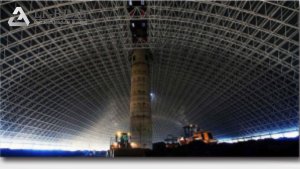
When key information is missing, suppliers may make different assumptions about loads, materials and scope. These differences can lead to significant variations in their quotations. Both quote the same footprint, and the numbers are not comparable.
The risk surfaces later: who absorbs the cost when discrepancies between structural base-plate and anchor-bolt details and the approved foundation drawings, or when the cladding interface changes after fabrication has started? The RFQ should also clarify whether the supplier is responsible for transportation, on-site installation or installation guidance, as these responsibilities affect the overall project cost and schedule. Scheme drawings at the proposal stage serve layout and pricing discussion only; they are not fabrication documents. Locking the structural system and package boundary before fabrication starts prevents re-engineering later.
building function and dimensions — span, length, clear height
site location, wind and seismic data if known, corrosion environment
equipment interfaces — conveyor supports, crane beams, process openings
package boundary — supply only, supply with installation guidance, or installed
protection and finishing — galvanizing, paint system, cladding specification
delivery terms, schedule expectations and payment structure
Q: Can a supplier estimate from a footprint and an assumed height?
A: Only as a screening figure with clearly stated assumptions. A per-square-metre estimate is useful for comparing order of magnitude, not for setting a budget — the spread between optimistic and conservative assumptions on loads and span can be substantial.
Q: What if the equipment layout is not final yet?
A: That is normal in mine projects. The structure can often be designed against a defined equipment envelope — clearances, support points and loads — instead of final machine positions. What matters is that the envelope is stated in the RFQ rather than left to the bidder.
Q: When should the structural package be defined?
A: Before the EOI or RFQ is issued. Owners who settle the building list and package boundary first receive more comparable bids and fewer post-award changes. If the EOI is already out with an undefined scope, the practical step is to ask the scope questions before responding, not after.
Building list, spans, clear heights, site conditions, loads and package boundaries are not paperwork. They are the difference between comparable bids and pricing assumptions, between a smooth interface and a discovery on site.
LF-BJMB supports large-span steel structure projects through structural design, scheme optimization and manufacturing. Early technical coordination helps clarify project requirements and establish a more reliable basis for subsequent engineering and delivery.For project references, see our solutions page.
Copyright © Xuzhou LF Engineering & Construction Co., Ltd. All Rights Reserved.


 +86 177 5198 6706
 +86-516-8595-0258


