

+86 177 5198 6706
222, Block B, Diamond International, Guozhuang Road, Xuzhou, Jiangsu, China
In mining areas, port terminals, and open industrial stockyards, large-span arched coal sheds are widely used for bulk material storage. From a structural perspective, most of these projects perform well at handover stage and fully meet design and inspection requirements, including:
Code-based strength verification
Welding appearance and NDT inspection
Global load-bearing capacity checks
However, in actual long-term operation, a recurring pattern appears across many projects:
Fine cracks gradually forming at welded joints
Local coating damage around node areas
Increasing frequency of maintenance and repair work
These issues are often not visible during final acceptance. They typically emerge after 3–5 years of exposure to real site conditions. Field experience shows that in most cases, this is not a construction quality issue, but a long-term fatigue problem driven by thermal stress accumulation that is not fully addressed in early design and detailing.
Many coal sheds operate in open environments such as surface mines and coastal terminals, where daily temperature variation can easily exceed 40°C.
For long-span arched steel structures (often exceeding 100 meters), this creates a continuous cycle:
Steel expands during daytime heating
Steel contracts during nighttime cooling
The process repeats every day throughout the service life
Even though each individual deformation is small, the repeated cycle generates continuous internal thermal stress within the structure.
In many conventional designs, connections are assumed to be fully rigid, with limited consideration for deformation release. When thermal movement is restrained, stress does not disappear—it is transferred and gradually concentrated at welded joints, transitions, and support zones.
Over time, this repeated low-amplitude stress cycle becomes the main driver of fatigue cracking.
A common engineering assumption in practice is that higher stiffness means better structural safety. This is only partially correct and depends heavily on service conditions.
For long-span outdoor steel structures, fully rigid systems introduce several long-term issues:
Restriction of natural thermal movement
Lack of stress redistribution paths
Concentration of deformation at welded details
In other words, the structure becomes over-constrained.
Instead of dissipating thermal deformation across the system, the structure forces all strain energy into a limited number of vulnerable points, especially weld toes and connection transitions.
This is why many coal sheds perform well at handover but gradually develop fatigue-related issues during service life.
Weld cracking in large-span coal sheds is rarely the result of a single extreme load event. In most observed cases, it follows a slow fatigue process:
Initial stress concentration at weld toes
Local coating cracking and exposure
Micro-crack initiation under cyclic stress
Progressive crack growth over time
Three long-term environmental factors typically act together:
Daily thermal expansion and contraction
Continuous wind and sand exposure
Repeated tension-compression cycles at rigid joints
By the time cracks become visible during inspection, fatigue damage has usually accumulated over years of operation.
In practical engineering optimization for long-span coal sheds, the focus is not on increasing stiffness indefinitely, but on managing how the structure behaves under thermal and environmental loading.
A more stable long-term performance is usually achieved through:
Segmenting long-span arch systems to reduce accumulated thermal strain
Introducing sliding or buffer-type connection details at key nodes
Adjusting stress distribution at arch foot and support zones
Avoiding excessive weld concentration in high-stress transition areas
Creating clear deformation release paths within the global system
The objective is not to weaken the structure, but to prevent unnecessary stress concentration and allow controlled thermal movement within a safe range.
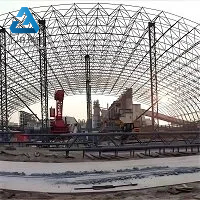
For large-span coal storage sheds operating in harsh environments, structural safety cannot be evaluated only through static strength checks.
Long-term performance depends on whether the structure can:
Absorb repeated thermal movement
Avoid localized stress concentration at welded joints
Maintain stable fatigue resistance over long service periods
A structure that is fully rigid at completion may still experience progressive fatigue issues in service if thermal effects are not properly considered.
In this context, controlled deformation is not a defect—it is part of structural durability design.
Weld cracking in large-span coal sheds is generally a lifecycle design issue rather than a construction quality problem.
The key missing factors in many conventional designs include:
Extreme daily temperature variation
Long-term thermal fatigue accumulation
Lack of node-level stress release strategy
Addressing these factors at the early design and detailing stage can significantly reduce long-term maintenance demand and extend the service life of steel structures in mining and port environments.
LF-BJMB specializes in steel structure subcontracting for large-span coal sheds and bulk material storage systems in demanding environments.
Our engineering focus includes:
Thermal stress behavior in large-span steel structures
Node-level deformation and fatigue control with customized steel truss joint
Weld detail optimization for long-term durability
Construction-compatible connection design
By integrating thermal stress release considerations into early-stage detailing and fabrication planning, we aim to reduce long-term weld fatigue risks and stabilize lifecycle maintenance costs for large-span steel structures in real operating conditions.
Copyright © Xuzhou LF Engineering & Construction Co., Ltd. All Rights Reserved.


 +86 177 5198 6706
 +86-516-8595-0258


