

+86 177 5198 6706
222, Block B, Diamond International, Guozhuang Road, Xuzhou, Jiangsu, China
We have long delivered large-span steel coal sheds for mines and ports worldwide. There is a common phenomenon in the industry: two industrial sheds with identical span, functional requirements and similar appearance can still have a price difference of 20%–30% between different manufacturers.
Most buyers believe the price gap comes from profit differences. However, based on our overseas project experience, the real reason lies in different design standards, risk control methods and the completeness of technical services adopted by each supplier.Choose standardized overseas steel subcontract solutions to avoid hidden cost risks brought by uneven supplier standards.
Low-cost quotations reduce the initial contract price by lowering design standards, material specifications and technical support. All hidden risks are reserved for on-site construction.
Low-cost designs omit targeted verification for local extreme weather such as typhoons, sandstorms and drastic temperature changes. They only apply general empirical values, resulting in insufficient structural safety margins for harsh overseas mining and port environments.
To reduce steel consumption, component sections are minimized, making the structure operate near the design limit. Slight deformation during ocean transportation or minor assembly deviation on-site can easily cause structural safety hazards.
Only a single primer layer is applied without hot-dip galvanizing and multi-layer composite coating. In high-salt-fog and dusty coastal and mining areas, steel components corrode quickly and lose long-term durability.
Bolt quantities and connection plates are reduced to cut factory processing costs. This leaves almost no adjustment tolerance during installation. Any component misalignment requires additional on-site reinforcement and modification.
Low-cost quotes exclude hoisting guidance, transportation loss compensation, third-party drawing review coordination and on-site installation support, leading to continuous extra costs during project implementation.
The higher price does not represent higher profit. The extra cost is invested in proactive risk control during the design stage to avoid later construction problems.
All structural designs comply with GB, EN and ASTM international standards. Unified load calculation logic ensures smooth drawing approval in various overseas regions.Our multi-norm unified design system avoids cross-border drawing approval obstacles effectively.
We comprehensively verify wind, sandstorm, typhoon, temperature difference and long-term fatigue loads to guarantee long-term structural stability for large-span storage sheds.
Steel components are segmented according to standard container dimensions and local hoisting capacity, avoiding oversized parts that cannot be shipped or require secondary cutting on-site.
Custom hot-dip galvanizing and multi-layer coating systems are configured according to project service life and environmental corrosion levels, effectively reducing long-term maintenance and replacement costs.
Wind load values, load combination rules and safety factors vary greatly in different national codes. Low-cost schemes generally adopt simplified formulas without local meteorological data verification, resulting in inadequate structural safety.
Empirical rough design is fundamentally different from finite element refined optimization in steel consumption control, safety reserve and long-term structural stability.
Steel grade is only a basic index. The real cost difference comes from hot-dip galvanizing quality, coating thickness and complete weather-resistant anti-corrosion configuration, which determine the full lifecycle performance of steel structures.
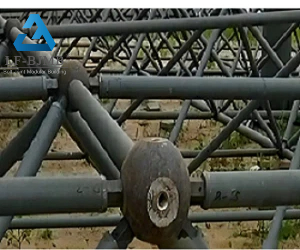
Structures with similar appearances may have completely different connection standards. Simplified nodes reduce initial cost but cause high modification and reinforcement expenses during on-site assembly.
Complete construction guidance, ocean freight coordination and drawing support effectively control invisible costs, while incomplete service leads to continuous budget overruns.
Most on-site construction problems result from incomplete preliminary design that ignores actual overseas site conditions. Typical issues include mismatched component sizes and hoisting equipment, unreasonable segmentation disrupting installation procedures, shipping deformation enlarging assembly errors, and insufficient adjustment margins, all leading to compulsory on-site rectification.
For overseas large-span steel structure projects, quotation differences are not caused by profit margins. The essential distinction is whether potential project risks are eliminated in the design phase or passed on entirely to the construction site.
Copyright © Xuzhou LF Engineering & Construction Co., Ltd. All Rights Reserved.


 +86 177 5198 6706
 +86-516-8595-0258


