

+86 177 5198 6706
222, Block B, Diamond International, Guozhuang Road, Xuzhou, Jiangsu, China
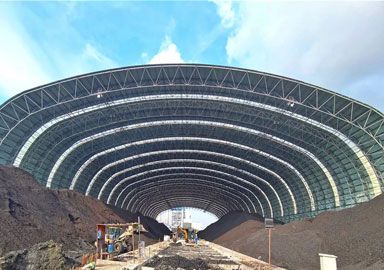
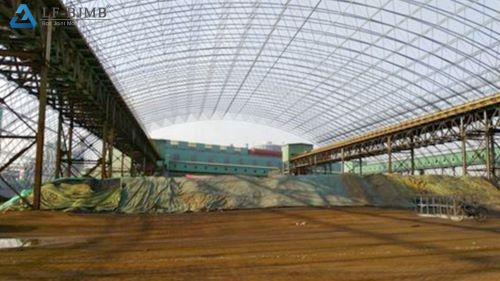
Ore and concentrate storage sits between the mine and the processing plant. It covers run-of-mine ore, crushed ore and mineral concentrate in a covered shed that protects material from rain, controls dust, and feeds the plant on schedule. For a mine operator or processing plant, the shed must handle abrasive ore, heavy loaders and often a remote site — bolted space frame barrel arches are the standard answer.
Open ore yards lose fine ore to rain and wind, freeze in cold climates, and spread dust across the mine site. A covered shed keeps ore at a consistent moisture level, lets the crusher and mill run without weather stops, and reduces dust around the plant.
The shed is part of the mine process flow: the truck dumps run-of-mine ore at one end, a feeder or stacker builds the pile, and a reclaimer or belt feeder draws material to the crusher and mill at the other end.
Run-of-mine ore binsfor truck-dumped primary crusher feed.
Crushed ore shedsbetween primary and secondary crushing.
Concentrate storage shedsfor filtered concentrate before shipping or stockpiling.
Ore sorting and blending shedswhere material is mixed by grade.
Reagent and additive storagenear the processing line.
Ore sheds use barrel arch space frames spanning 30 to 80 meters, clear for dump trucks, loaders and reclaimers. The floor is reinforced for heavy truck traffic, and the structure is sized for the abrasive material inside.
For remote mine sites, members ship in standard containers and are bolted together under supervision. Because the frame is demountable, it can be re-erected if the ore body moves or the pit shifts.
Mines are remote, and local steel fabricators are usually far away. LF-BJMB ships the shed in containers, guides local crews through erection, and designs the roof around the feeder and reclaimer envelope.
Abrasion-resistant design— interior sized for heavy loaders and ore trucks.
Container delivery— members fit standard containers to remote mine sites.
Demountable frame— can be re-erected as the pit moves.
Coordinated flow— roof designed around feeder and reclaimer positions.
Ore sheds that underperform usually miss one of these in the first layout.
Truck dump height— door and clearance sized for the largest dump truck.
Feeder and reclaimer positions— belt openings agreed with process flow.
Floor load— reinforced for heavy truck traffic and ore piles.
Dust control— extraction points attached to the roof grid.
Q1: What span do ore storage sheds cover?
A:Barrel arch space frame ore sheds commonly span 30 to 80 meters, matched to the pile size and the loader or reclaimer envelope.
Q2: Can the shed handle abrasive ore and concentrate?
A:Yes. The interior is sized for heavy loaders, the floor is reinforced, and the coating is selected for dusty, abrasive mine conditions.
Q3: Can the shed be moved if the pit shifts?
A:Yes. The bolted frame is demountable and can be re-erected at a new location as the mine develops.
An ore storage shed keeps the mine-to-mill flow running in any weather. Starting from the truck, the feeder and the reclaimer gives a shed that works as part of the process, not as a box over the pile.
LF-BJMB designs and builds space frame ore and concentrate storage sheds for mines worldwide, with free proposals for new and expanding operations.
For more project cases, visit our news center.
Copyright © Xuzhou LF Engineering & Construction Co., Ltd. All Rights Reserved.


 +86 177 5198 6706
 +86-516-8595-0258


