

+86 177 5198 6706
222, Block B, Diamond International, Guozhuang Road, Xuzhou, Jiangsu, China
In spatial grid structures, the support is the “joint” connecting the superstructure and the substructure. It must not only transmit loads but also adapt to complex conditions such as temperature deformation and seismic action.
Choosing the wrong support can lead to structural cracking or even serious safety accidents.
This article, combining the *Technical Specification for Spatial Grid Structures* (JGJ7-2010) with practical engineering cases, shares my understanding and selection logic of fixed hinge supports, elastic supports, and sliding supports.
Article 5.9.1 of the *Technical Specification for Spatial Grid Structures* (JGJ7-2010) specifies the basic requirements for support nodes in spatial grid structures.
Support nodes in spatial grid structures must have sufficient strength and stiffness, and should not fail before members and other nodes under load, nor should they produce non-negligible deformation.
The construction of support nodes should ensure reliable force transmission, simple connection, and conform to calculation assumptions.
In structural mechanics, a “rigid body” is an important idealized model, whose fundamental assumption is that an object does not undergo any deformation under the action of forces (i.e., the relative positions of all points within it remain unchanged).
However, in real life, absolutely rigid bodies do not exist; rigidity and elasticity are only relative concepts.
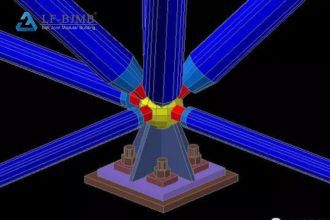
Common support types for space frames generally include fixed hinge supports, elastic supports (specifically rubber supports in this article), and sliding hinge supports. The construction methods and characteristics of each support type are well-known.
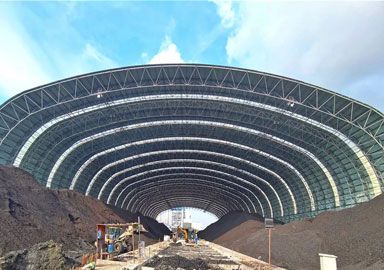
In practical engineering cases, space frames are generally used for large-span structures.
The supporting structure beneath the grid can take various forms.
Some have a steel/concrete frame structure at the bottom (roughly divided into those with and without floor slabs).
Some have a steel/concrete independent column structure at the bottom, while others span different buildings, serving as the roof of a podium or atrium.
JGJ7-2010 emphasizes the interaction between the upper spatial grid structure and the lower supporting structure.
Co-analysis of spatial grid structures allows the equivalent stiffness and mass of the substructure to be used as conditions for analyzing the upper spatial grid structure.
Alternatively, the equivalent stiffness and mass of the upper spatial grid structure can be used as conditions for analyzing the substructure.
For some projects, engineers can also analyze the upper and lower structures as a single system.
By considering the substructure, stiffness and elasticity can be transformed into each other.
Therefore, engineers cannot select a support system solely based on the grid structure itself.
Discussing support selection without considering the substructure type is meaningless. Even with a clear understanding of the characteristics of various supports, most people will likely remain confused when dealing with practical projects without considering the substructure type.
Copyright © Xuzhou LF Engineering & Construction Co., Ltd. All Rights Reserved.


 +86 177 5198 6706
 +86-516-8595-0258


