

+86 177 5198 6706
222, Block B, Diamond International, Guozhuang Road, Xuzhou, Jiangsu, China
Coal storage is one of the most demanding applications of large-span steel structures, and there is no single structure type that fits every project. The right choice depends on your stockpile capacity, site shape, handling equipment, local loads and budget — which is why owners should compare at least two or three structural systems before asking for a detailed quote.
For a project owner, engineering consultant or general contractor preparing a coal storage facility, understanding how structure types differ is the first step toward a design that is safe, economical and build on your specific site.
For medium and large coal storage, the most common options are:
(1)Bolt ball structure : a three-dimensional system that carries loads in all directions, suitable for irregular plans and large spans with a relatively light steel weight per square metre.
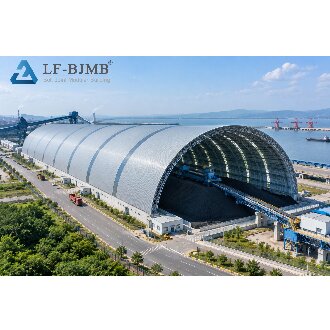
(2) Latticed shell / latticed arch: a curved system that works well for long, narrow stockyards and domed covers, with efficient load transfer along the curvature.
(3) Rigid frame : the most economical choice for smaller spans and simple rectangular buildings, but less efficient when the clear span grows beyond roughly 40–60 meters.
(4) Truss system: a classic solution with a simple fabrication and erection process, though it often requires more columns or shorter spans than a space frame.
The practical choice for most large coal storage projects is between a space frame and a latticed shell or arch, with rigid frames reserved for small facilities.
Storage capacity and the shape of the stockpile area are the two most basic inputs.
A rectangular stockyard of, say, 120m × 200m with a single stockpile is a natural fit for a space frame or latticed arch, because the roof can cover the whole rectangle without internal columns. An irregular site — one that follows an existing conveyor corridor or a curved plot boundary — is much easier to cover with a space frame, which adapts to any plan geometry, than with a truss system that prefers regular, repeated bays.
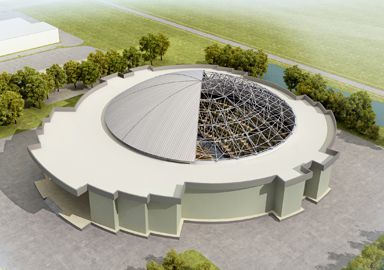
A domed or circular plan changes the answer again: a latticed dome is often the most efficient form for circular storage, both in steel weight and in the absence of corners where wind and dust concentrate.
Coal storage is not only about covering the stockpile. Stackers, reclaimers, belt conveyors and mobile equipment must operate underneath the roof, and the structure must leave them enough clearance.
This affects both the roof height and the support layout. For example, a circular stockpile with a centre column is often unacceptable because the reclaiming equipment needs the full radius clear. A space frame can bridge the full span and keep the interior completely open, while a truss system might require intermediate supports that interfere with the equipment envelope.
Before selecting a structure type, the owner should confirm the equipment manufacturer’s clearance envelope — this single input eliminates several structure types immediately.
The governing loads on a coal storage structure are often asymmetric, and different systems respond to them differently.
(1) Stockpile loading: coal piled against one wall produces one-sided horizontal pressure on the lower structure, which must be verified for every system.
(2) Wind and snow: a large curved roof experiences wind suction patterns and snow drifting that differ from a flat or pitched roof; curved surfaces can shed snow unevenly, creating unbalanced loading.
(3) Seismic and temperature: in seismic zones or regions with large temperature swings, the structure’s stiffness distribution and support detailing become important.
A space frame distributes asymmetric loads three-dimensionally, which is an advantage on irregular loading; a rigid frame carries them more directly through its frames. The owner does not need to perform these calculations, but should know that the load cases — not the span alone — often decide which system is safe and efficient.
The cheapest system on steel weight is not always the cheapest project overall.
A space frame usually achieves a lower steel weight per square metre at large spans, but its nodes and fabrication are more complex, and erection often requires more careful sequencing. A truss or rigid frame is simpler to fabricate and erect, but uses more steel or needs more supports at the same span.
Total cost should therefore be compared as: steel weight + fabrication + surface treatment + transport + erection. A supplier that quotes all of these for two or three systems on your actual plan gives you a far more useful comparison than a single unit-price figure.
Many coal storage projects today are driven by environmental regulation — dust control, rainwater runoff and visual enclosure.
If the facility must be fully enclosed for dust control,a fully cladded space frame or shell is the natural solution. If partial enclosure or wind-break walls are acceptable, simpler and cheaper systems may be used. Ventilation and gas detection for potential methane accumulation may also be required for enclosed coal storage, which affects roof openings and equipment — another reason to define environmental requirements before the structure is selected.
The final decision should be a joint one, but the owner should set the inputs.
The owner’s responsibility is to provide: storage capacity, site plan and shape, equipment clearance, local loads and codes, environmental requirements and budget range. The supplier’s responsibility is to present two or three viable systems, with tonnage, cost, fabrication and erection comparisons on that specific project.
Any supplier that insists on a single system without comparing alternatives should be asked why. In most projects, two different systems are both feasible, and the difference is a question of cost, schedule and site fit — which the owner is entitled to see before deciding.
Selecting the right structure type for a coal storage project is not a matter of picking the most common system — it is a matter of matching the system to the stockpile plan, the handling equipment, the local loads and the environmental requirements. Owners who define these inputs clearly, and ask suppliers to compare two or three systems on their actual site, consistently end up with a design that is cheaper, safer and faster to build. For a first estimate, provide the storage capacity, site shape and equipment clearance, and most suppliers can respond with a preliminary comparison within days.
A: Yes. Bolt ball structure systems regularly cover clear spans of 100–150 meters in coal storage projects, keeping the full interior open for stackers and reclaimers.
A: For small facilities with spans up to roughly 40–60 meters, a rigid frame is often the most economical option. Beyond that span, bolt ball structure or shell systems become more competitive.
A: Choosing based on a unit price or steel weight alone, without comparing fabrication, erection and the equipment clearance requirements — which is what usually drives the final cost.
Copyright © Xuzhou LF Engineering & Construction Co., Ltd. All Rights Reserved.


 +86 177 5198 6706
 +86-516-8595-0258


