

+86 177 5198 6706
222, Block B, Diamond International, Guozhuang Road, Xuzhou, Jiangsu, China
In recent years, the rapid pace of urbanization has led to a sharp increase in demand for large-span and open-plan buildings, such as libraries, exhibition halls, and sports arenas. Steel structures have seen widespread development and application due to their high strength, good ductility, light weight, excellent seismic performance, and high degree of prefabrication. As a specialized form of steel structure, bolted spherical node truss structures require a high degree of precision during construction and are subject to complex and variable loading conditions. Due to these complexities, truss structures that have been in use for extended periods often require structural reinforcement.
At a power plant located in a coastal region, the 30-year-old dry coal storage shed structure has developed structural corrosion issues due to high ambient humidity, necessitating structural reinforcement. Based on this real-world case, this study aims to summarize the construction methods for reinforcing bolted spherical node space frame structures.
1.Project Overview
The power plant is situated in a coastal area and is frequently affected by typhoons. The power plant has a total installed capacity of 5.3 million kW. Its coal yard is a linear-type facility with a coal pile height of 12 m, a length of 254 m, and a width of 208 m, initially designed to accommodate a total coal stockpile of 180,000 t.
The coal yard layout adopts a parallel linear configuration, with a coal transfer station and a slurry settling pond situated on the north and south sides, respectively, and surrounded by a circular fire access road. Within the coal yard, a steel-structured dry coal shed in the form of a space frame was constructed (Fig. 1), with a length of 88 m and a span of 103.5 m. The two ends of this dry coal shed utilize existing windbreak and dust suppression walls as enclosure facilities for the storage and protection of coal. A bolted-sphere space frame coal shed is a structure used for storing coal and other bulk materials, featuring large spans and high load-bearing capacity. The coal shed employs a double-layer cylindrical grid shell structure with obliquely placed four-corner cones. Although it has been in service for over 30 years, severe structural aging necessitates urgent repair and reinforcement.
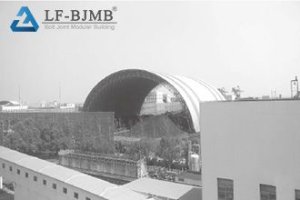
(a)
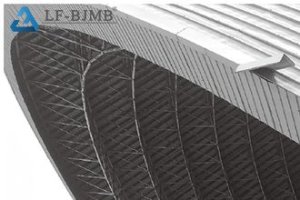
(b)
Fig. 1 Original Dry Coal Shed
(a) Distant view; (b) Close-up
2.Reinforcement Conditions and Technical Requirements for the Dry Coal Shed
2.1Reinforcement Conditions
The dry coal shed is a double-layer cylindrical grid shell with four obliquely placed cones (Fig. 2). The unfolded plan dimensions of the space frame are 139.2 m × 88 m, with a column spacing of 4 m and a span of 103.5 m. The dimensions of the space structure members are A75 mm × 3.75 mm, A89 mm × 4.00 mm, A114 mm × 4.00 mm, A140 mm × 4.00 mm, A159 mm × 6.00 mm, A159 mm × 7.00 mm, A159 mm × 8.00 mm, A219 mm × 14.00 mm, and A273 mm × 15.00 mm, with Q235 grade steel used as the material; Most joints are bolted spherical joints, while the bottom chord supports and some top chord supports use welded spherical joints. The spherical joint diameters are 150 mm, 650 mm, etc. The material is Grade 45 steel as specified in GB/T 699—1999 “High-Quality Carbon Structural Steel,” meeting the requirement of a tensile strength of no less than 355 N/mm²; The main purlins are made of C16a steel with a cross-sectional dimension of 160 mm × 63 mm × 6.5 mm, while the secondary purlins are thin-walled Z-shaped steel with a cross-sectional dimension of 140 mm × 50 mm × 20 mm × 3.0 mm; all purlin connection joints are welded. The space frame foundation uses pile foundations, with precast concrete square piles spaced 450 mm × 450 mm; the space structure supports use spring bearings.
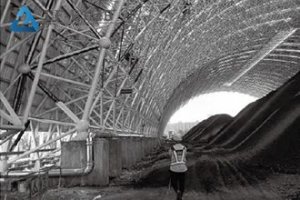
Figure 2. Dry Coal Shed Supports
Due to severe damage to the components near the supports on both sides of the coal shed, a significant safety hazard was posed. During replacement and reinforcement, a support frame must be used to prevent the coal shed’s grid structure from collapsing.
The main tasks of the major overhaul of the original dry coal shed steel structure were: (1) replacement of all supports; (2) reinforcement and repair of the supports near the supports; (3) replacement or reinforcement of all overstressed components; (4) reinforcement of local concrete foundations; (5) calculation of the impact of adding ventilation shafts and walkways on the original coal shed grid structure, and replacement of overstressed components.
Before reinforcement, a finite element simulation of the wind load on the grid structure was performed. The basic wind pressure during the repair process was taken as 0.35 kN/m², and snow load and variable load on the roof were not considered, with other conditions remaining unchanged.
The calculation results of the structure under different load combinations are shown in Figure 3. The maximum stress of the components was -173 to 145 N/mm², indicating structural safety.
Figure 3 Wind Load During Space Structure Repair
2.2 Technical Requirements
The major repair of the bolt-ball space frame coal shed steel structure begins with the expansion of the coal shed’s steel space frame. The expanded coal shed will have the same structural form and external dimensions as the original shed, extending to the existing windbreak and dust suppression walls. Both ends of the expanded shed will utilize the existing windbreak and dust suppression walls as enclosure facilities. This includes, but is not limited to, all concrete foundations of the coal shed, fabrication and installation of the steel space structure , including secondary design, steel space structure processing, fabrication, installation (painting and finishing), purlins, profiled steel roof installation, skylight installation, lighting fixtures, lightning protection installation, etc.
This major repair of the original coal shed steel structure requires the completion of secondary design, fabrication, supply, installation, secondary grouting, and related technical services, necessary testing, acceptance, final delivery, and after-sales service for the entire coal shed building structure.
The structural design service life is 50 years. Permanent loads: Roof panel 0.3 kN/m²; Lower chord walkway 1.0 kN/m². Variable loads: Roof panel 0.5 kN/m², considering unfavorable arrangements for half-span variable loads; lower chord walkway 2.0 kN/m². Temperature loads: Considered based on the structure’s service temperature within -30 to 30°C of the installation temperature.
All components of the steel space structure (including bolt balls, rods, high-strength bolts, supports, etc.) should be fabricated in the factory and have factory certificates of conformity and inspection records. The thread processing of steel balls and bolts should be carried out by the space structure manufacturer according to current national standards, but all must meet the stress and deformation requirements of the space structure design and construction stages. Steel balls should be marked with their workmanship number, and all weldments should have welder numbers.
Copyright © Xuzhou LF Engineering & Construction Co., Ltd. All Rights Reserved.


 +86 177 5198 6706
 +86-516-8595-0258


