The Hidden Risk of Treating Corrosion Protection as a Painting Decision
Many steel structures do not develop corrosion problems because the coating system was completely wrong.
In many cases, the real problem started much earlier — when corrosion protection was considered only after engineering, fabrication, and cost decisions had already been completed.
The common sequence in industrial projects is familiar:
-
The structural design is approved.
-
Fabrication planning is finalized.
-
Production costs are calculated.
-
Transportation arrangements are confirmed.
Then the project team asks:
“Which coating system should be applied?”
This question is necessary.
However, by this stage, many factors affecting corrosion performance have already been determined.
Corrosion protection is not simply a matter of choosing paint.
It is part of the engineering process that connects structural design, fabrication quality, environmental conditions, and long-term maintenance requirements.
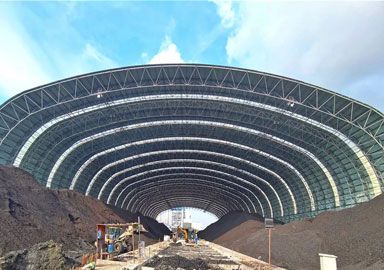
For large-span steel structures used in mining facilities, power plants, port terminals, and bulk material storage projects, corrosion resistance depends on much more than the final coating layer.
The coating is only the last protective barrier.
Long-term performance is also influenced by:
A well-selected coating system can provide excellent protection, but it cannot fully solve risks created before fabrication begins.
The Real Cost of Corrosion Appears After Installation
At the beginning of a steel structure project, most costs are easy to identify:
-
-
Steel weight
-
Fabrication cost
-
Transportation expenses
-
Installation schedule
These factors are visible during project evaluation.
Corrosion-related costs are different.
They often appear years after the structure has entered service.
Typical consequences include:
-
-
additional maintenance work
-
difficult repair conditions
-
unexpected recoating
-
operational interruptions
-
reduced service life
For large-span industrial structures, these risks can become more serious because many structural areas are located at height or in locations that are difficult to access after operation begins.
Industrial storage facilities, material handling structures, and large roof systems may require additional equipment and planning when maintenance work is needed.
Once corrosion develops in difficult-to-reach areas, repair is no longer a simple coating issue.
It becomes a maintenance and operational challenge.
A small saving during fabrication can create a much larger cost later.
Therefore, corrosion protection should not be evaluated only by the initial coating price.
The more important consideration is whether the protection system can continue performing under real operating conditions throughout the expected service life.
Corrosion Protection Planning Starts Before Coating Application
A typical fabrication sequence may look simple:
For engineering-focused contractors, corrosion protection is considered together with structural requirements, fabrication methods, transportation conditions, and installation procedures.
The first question is not only:
“Which coating system should be used?”
It is also:
“What conditions will this structure face after installation?”
Different industrial environments create different corrosion challenges.
A coastal terminal may experience salt spray and continuous humidity.
A mining facility may face dust accumulation, industrial contamination, and demanding maintenance conditions.
A power or processing facility may involve chemical exposure and temperature changes.
For professional steel structure subcontractors, protection planning starts by understanding:
-
-
environmental exposure category
-
required service life
-
future maintenance conditions
-
accessibility after installation
The most suitable protection system is not always the most expensive option.
It is the system selected according to the actual operating environment.
Surface Preparation Determines Coating Performance
The durability of any coating system depends heavily on the quality of the steel surface underneath.
Surface preparation is often invisible after fabrication, but it directly affects coating adhesion and long-term corrosion resistance.
Poor surface preparation may not create immediate problems.
The structure may pass inspection.
The project may still be delivered on schedule.
However, weak adhesion and premature corrosion can appear years later during operation.
This is why professional fabrication control pays close attention to:
-
-
abrasive blasting quality
-
surface cleanliness
-
surface profile verification
-
inspection before coating application
For industrial steel structures, surface preparation is not simply a workshop procedure.
It determines whether the selected coating system can achieve its expected durability.
Selecting an Anti-Corrosion Coating System Based on Actual Conditions
There is no universal coating solution suitable for every steel structure.
For industrial steel structures, protection strategies are commonly evaluated according to standards such as ISO 12944.
ISO 12944 helps define suitable coating systems by considering atmospheric corrosion categories and expected durability requirements.
This means coating selection should be based on actual project conditions rather than simply choosing the lowest-cost option or applying the same specification to every project.
A typical high-performance protection system may include:
-
-
Sa 2.5 abrasive blasting for surface preparation
-
zinc-rich epoxy primer for corrosion resistance
-
epoxy intermediate coating for barrier protection
-
polyurethane top coat for weather resistance
However, coating materials alone do not determine long-term performance.
The complete protection process must remain effective during transportation, installation, and years of operation.
Fabrication Control Protects Corrosion Performance Before Delivery
A steel structure does not lose corrosion resistance simply because it leaves the factory.
Problems usually appear when important fabrication details are overlooked.
During manufacturing, corrosion protection requires control of:
-
-
coating consistency
-
dry film thickness
-
weld area treatment
-
edge protection
-
inspection records
For large-span industrial steel structures, fabrication planning must also consider transportation handling, site installation conditions, and future maintenance requirements.
These structures often include extensive exposed steel surfaces and areas that become difficult to inspect after operation begins.
Therefore, corrosion protection cannot be separated from fabrication planning.
It must be considered as part of the complete steel structure delivery process.
Passing inspection is only the basic requirement.
The real measure of quality is whether the structure remains protected after installation.
Why Engineering-Focused Steel Structure Partners Think Differently
The difference between steel structure suppliers is not only manufacturing capability.
Many companies can fabricate steel components and provide inspection documentation.
The bigger difference is how they define responsibility.
A cost-focused approach usually concentrates on reducing initial expenses.
An engineering-focused approach considers the future condition of the structure:
-
-
How will it perform in the operating environment?
-
What maintenance challenges may appear years later?
-
How can corrosion risks be controlled before they become operational problems?
For large-span industrial structures, these decisions directly influence lifecycle value.
A professional steel structure partner does not only deliver fabricated components.
The responsibility continues through ensuring that the structure is prepared for real service conditions.
LF-BJMB Approach: Integrating Corrosion Protection Into Steel Structure Delivery
At LF-BJMB, corrosion protection is treated as part of the complete steel structure delivery process rather than an independent coating activity.
For large-span industrial steel structures used in storage, mining, and infrastructure applications, corrosion considerations are coordinated with:
By considering corrosion risks during engineering and fabrication stages, LF-BJMB helps project partners reduce:
-
-
premature corrosion risks
-
unexpected maintenance requirements
-
repair caused by insufficient preparation
-
uncertainty during operation
A professional steel structure partner provides more than components manufactured according to approved drawings.
The value comes from delivering structures that are engineered, fabricated, and prepared for long-term operation.
Conclusion
Steel structure corrosion protection should never be treated as a final painting decision.
When corrosion appears after installation, many important protection decisions have already been made.
Long-term corrosion resistance depends on decisions made throughout the entire process — from engineering planning and fabrication control to coating application and installation.
For large-span industrial steel structures, durability is not created by coating alone.
It is created by understanding the operating environment, controlling fabrication quality, and selecting protection strategies before problems occur.
A successful steel structure project is not only built to pass inspection.
It is built to continue performing reliably throughout its intended service life.




 +86 177 5198 6706
 +86-516-8595-0258


