

+86 177 5198 6706
222, Block B, Diamond International, Guozhuang Road, Xuzhou, Jiangsu, China
The main structure of Hangar No. 1—part of the China Eastern Airlines International Aviation Maintenance Service Platform project, which is set to become Asia’s largest hangar—has been fully completed, marking a major milestone in the project’s construction.
Located within the Shanghai Large Aircraft Industrial Park, the project has a total floor area of 113,000 square meters. It primarily comprises 11 individual structures, including the newly constructed Hangars No. 1 and No. 2, an aircraft parts warehouse, and a component repair center, as well as supporting outdoor facilities.
As the project’s core maintenance facility, Hangar No. 1 features a roof truss spanning 313.5 meters and a depth of 140.35 meters. It is currently the largest hangar hall in Asia and can accommodate nine Airbus A380 wide-body aircraft for maintenance simultaneously.
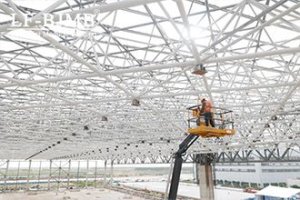
The hangar’s large span and depth posed significant challenges for roof structure design and material strength. The project team invited industry experts to conduct scientific assessments, repeatedly evaluated construction options, and actively adopted new technologies, processes, and materials to achieve multiple objectives:
The roof features a three-layer, diagonally braced, four-cornered conical welded spherical grid structure, constructed entirely from Q420 high-strength steel, making it the first project in the aviation sector to utilize this type of welded spherical grid structure.
An innovative “on-site assembly and lifting” construction method was employed for the roof. This involved lifting the roof structure—covering an area of approximately 41,000 square meters and weighing over 7,000 tons—21.4 meters in a single operation. This is equivalent to parking 90 Boeing 737 aircraft on six soccer fields and lifting them to the height of a seven-story building.
The application of these new technologies and construction methods has significantly reduced the risks associated with high-altitude work while improving construction precision and efficiency. The successful completion of this critical milestone has greatly accelerated the formation of the main structure.
Since the project’s commencement, the project team has strictly adhered to all requirements of refined management, scientifically conducting preliminary planning, efficiently coordinating various construction elements, and advancing all construction tasks safely, rapidly, and in an orderly manner.
During the foundation construction phase, facing challenges such as limited site space and complex layout planning, the project team leveraged BIM technology to conduct full-process virtual construction and site layout optimization. By building BIM models, they scientifically planned the functional zones of the construction site and continuously optimized the site layout by integrating construction personnel routes and material transport paths.
To ensure the smooth and safe hoisting of the space structure, the project team divided the assembly into three major zones, each comprising eight sub-zones. A total of 24 hoisting points and eight hoisting pump stations were established for the hoisting process. A series of monitoring sensors—including strain, temperature, and displacement sensors—were deployed to monitor roof deflection and stress changes in real time. A multi-level edge control system was adopted to ensure that the overall deformation of the space frame was controlled to within millimeters.
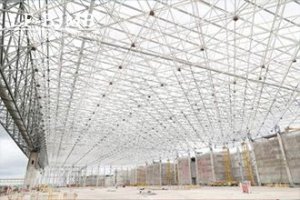
Upon completion, the project will provide high-quality, comprehensive services—including wide-body aircraft fuselage maintenance, retrofitting, and in-depth component repairs—to domestic and international aviation clients. It holds significant importance in supporting Shanghai’s efforts to establish itself as a comprehensive, multi-functional international aviation hub.
Copyright © Xuzhou LF Engineering & Construction Co., Ltd. All Rights Reserved.


 +86 177 5198 6706
 +86-516-8595-0258


