

+86 177 5198 6706
222, Block B, Diamond International, Guozhuang Road, Xuzhou, Jiangsu, China
When space structures are constructed in seismic zones, they must meet the following design requirements:
1. When the seismic design intensity is 7 or higher, horizontal bracing should be provided in the perimeter sections of the space structure within its support plane.
Theoretical calculations indicate that installing horizontal bracing can improve the horizontal seismic performance of space frames. For perimeter-supported space structures, there are three types of bracing configurations:
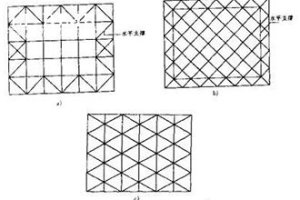
(1) Orthogonal arrangement (see Figure 1a): Diagonal members are installed within the perimeter grid to form a closed system.
(2) Orthogonal-diagonal type (see Figure 1b): Horizontal members are arranged along the boundary to form a closed system.
(3) Triaxial type (see Figure 1c): Since the support plane itself consists of geometrically stable triangles, no additional bracing is required.
2. The slenderness ratio of members within the 2–3 grid zones along the perimeter shall not exceed 180. This is because the internal forces in the perimeter chords of the space structure are relatively small under static loads. Under seismic loads, the dynamic-to-static ratio of seismic effects (i.e., the ratio of seismic effects to static effects) for perimeter members is always greater than 1, which often results in a change in the sign of the internal forces. Therefore, regardless of whether the members are under compression or tension, their allowable slenderness ratio is calculated based on compression.
3. For roof systems with purlins, the purlins must be securely connected to the space structure and have sufficient support length; if welding is used, the weld length shall not be less than 60 mm. For roof systems without purlins, the reinforced concrete roof slab must be securely welded to the space structure at three points, and the overhang length of the roof slab shall not be less than 80 mm. This is to prevent roof materials from collapsing and causing injury during an earthquake.
4. The drainage slope for space structure roofs should preferably be achieved through variable heights or by cambering the entire space structure. There are many methods for creating drainage slopes on space structure roofs. Previously, it was common in China to use small columns added at the top chord nodes to form the slope, which concentrates the roof load at the tops of these columns—a practice detrimental to the space frame’s seismic performance. Therefore, it is specified that variable-height space frames or arching the entire space frame should be used to distribute the roof load closer to the top chord nodes, thereby enhancing seismic resistance.
Copyright © Xuzhou LF Engineering & Construction Co., Ltd. All Rights Reserved.


 +86 177 5198 6706
 +86-516-8595-0258


